
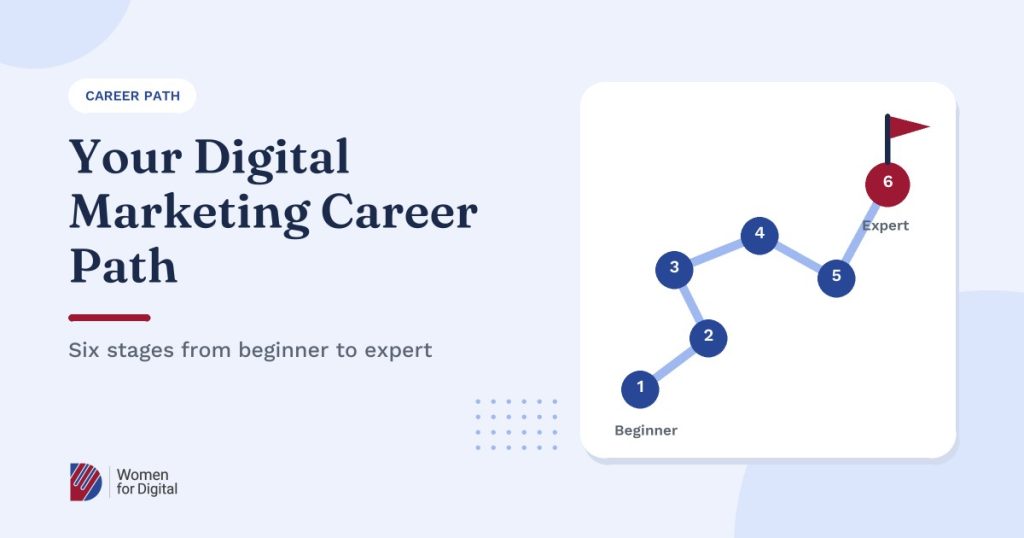
The digital marketing career path for beginners has six stages: foundation, entry-level, specialist, senior specialist, manager and executive. Sources disagree on how long each stage takes, so treat every timeline as a rough range. What moves you up is proof of results at each stage, not the number of years you have waited.
Key Takeaways
- Pay climbs in steps on the digital marketing career path for beginners, and the steps are big. Talent Scout’s US postings show median advertised pay of $62,814 for junior roles, $87,500 for mid-level and $135,000 for senior, so each stage you clear is worth real money.
- The top of the ladder is narrow and turns over fast. Spencer Stuart’s study of 329 Fortune 500 chief marketing officers found an average tenure of 4.3 years, so build a strong career at every stage, not only at the peak.
- Promotions are rarer than raises. In the Link in Bio survey, 51% of respondents got a raise in the past year, but only 24% got a promotion, so you need proof ready before you ask.
- Entry level is crowded and headcount is flat. Indeed Hiring Lab found that 49% of applications from workers with 10 or more years of experience went to entry-level roles, so a clear specialty beats a general pitch.
- Your first stage is the cheapest. Google’s certificate takes about six months at ten hours a week, and free courses cost nothing, so you can test the path before you spend a cent.
The Digital Marketing Career Path for Beginners Is a Ladder With Side Doors
Most guides draw one straight line from intern to chief marketing officer. Real careers bend. People jump from social media into paid ads, move from an agency to a start-up, or go freelance at year three and never return. So the honest way to read any map of the digital marketing career path for beginners is as a set of stages with several doors between them.
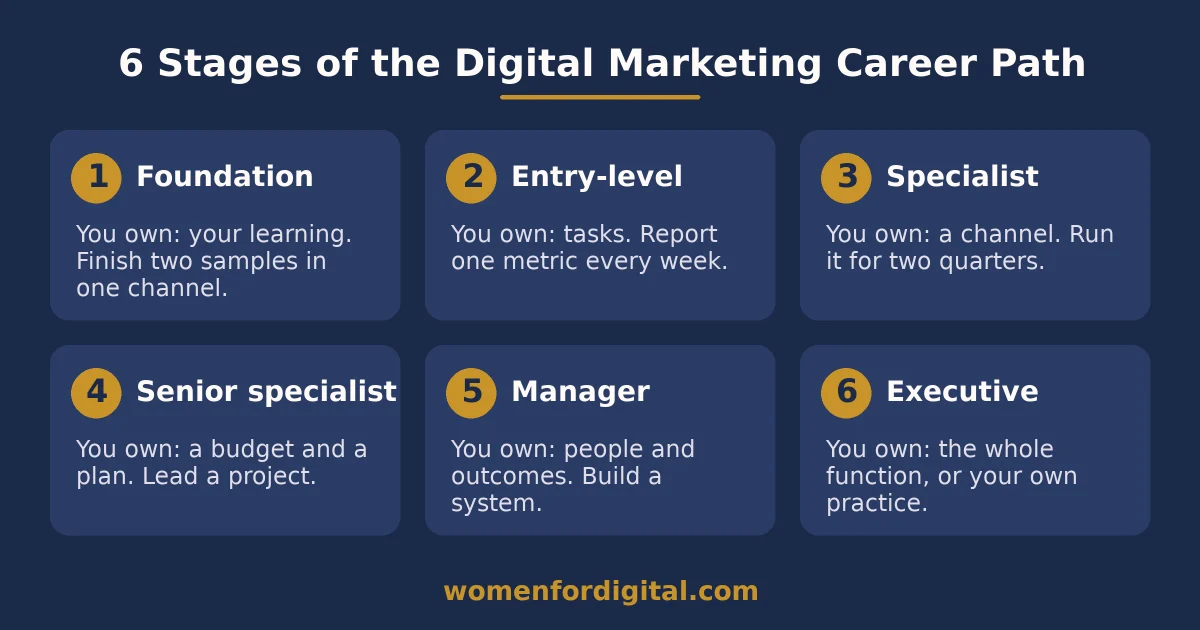
Stage names also vary by company. A “coordinator” at one firm does the work of a “specialist” at another. So this guide defines each stage by what you own: nothing, tasks, a channel, a budget, a team, then the whole function.
The timing is just as uneven. One guide from Kraftshala puts senior roles at four to nine years and leadership at ten or more. Setup’s career guide puts the chief marketing officer role at 20 or more years, while Academy of Continuing Education suggests 8 to 15 or more. None of these pages cites data for its ranges, so read them as opinions, not measurements.
My reading is that years are a poor unit. A person who owns a budget and reports results at year three often beats a person who has sat in the same seat for six. This guide gives you the stages, the evidence, a decision rule for each move and a 12-month plan.
What the Data Says About Demand and Pay Along the Path
Pay Rises Fastest Early on the Digital Marketing Career Path for Beginners
Talent Scout’s Marketing Hiring Gap Report analysed 6,731 US postings across 16 marketing roles. Among the 1,914 postings that stated a salary, the median was $62,814 for junior roles, $87,500 for mid-level roles and $135,000 for senior roles. Senior growth marketing managers reached $156,500.
Here is my arithmetic. Junior to mid-level is a jump of about 39%, and mid-level to senior is about 54%. By that measure, two promotions matter more than a long string of small raises.
These are American postings that state a salary, so pay in your country may be lower or higher. Still, the shape travels: pay compounds once you own results.
Demand Is Wide, but Budgets Are Tight
The same report found that 28.9% of postings were still open after 30 days. For social media managers the figure was 42.2%, for media buyers 40.6% and for video editors 34.5%. Its CEO called this a cost problem, not a recruiting problem.
Employers want the work done, but they resist paying full price for it. As a result, the people who move up fastest can show revenue or savings, not just activity.
Growth Sits in the Manager Layer
The US Bureau of Labor Statistics projects that employment of advertising, promotions and marketing managers will grow 6% over the next decade, which is faster than average. It counts 454,800 of those jobs and reports median annual pay of $165,780.
Notice the catch. The BLS lists a bachelor’s degree as the typical entry education and says marketing managers usually need related work experience. The early stages build that experience.
The 6 Stages of the Digital Marketing Career Path for Beginners
Each stage of the digital marketing career path for beginners has the same four parts: what you own, what it pays, how to know you are ready to move, and the trap that slows people down. Use the readiness test, not the calendar.
Stage 1: Foundation (About the First 3 to 6 Months)
What you own: nothing yet except your learning. Your job is to learn the basics of one channel and finish samples that prove it.
Google’s Digital Marketing and E-commerce Professional Certificate needs no degree or experience. It lists more than 190 hours of instruction and practice, paced at six months and ten hours a week. Free options such as HubSpot Academy and Google Skillshop cost nothing.
Ready to move when you have two finished samples in one channel and can explain the result of each in two sentences.
The trap: collecting certificates without producing work. A certificate says you finished a course. A sample says you can do the job, so build one sample for every course you complete.
Stage 2: Entry-Level Executor (Roughly Years 0 to 2)
What you own: tasks. You schedule posts, pull reports, write first drafts, build email lists and update ad copy. Typical titles include coordinator, assistant, associate and executive.
Junior postings in the Talent Scout data carry a median of $62,814. Competition is heavy at this door, though. Indeed Hiring Lab’s data shows 49% of applications from workers with 10 or more years of experience going to entry-level roles. Those veterans made up 30% of all entry-level applicants.
So you win with specificity. “I run click-to-message ads for independent fashion shops and cut cost per lead by a third” beats “I do digital marketing”. Our guide to a digital marketing career for beginners with no degree lists seven entry paths that produce this kind of proof quickly.
Ready to move when you own one metric, such as email open rate or cost per click, and you report on it every week without being asked.
The trap: staying a helper. If you only execute other people’s plans for two years, you will look junior on paper. Ask for one small channel of your own within six months.
Stage 3: Specialist (Roughly Years 2 to 5)
What you own: a channel. You plan and run SEO, paid ads, social media, email or content, and you answer for its numbers. Titles include SEO specialist, paid media manager and social media manager.
The Talent Scout median for mid-level roles is $87,500. That is a jump of about 39% over junior pay, so this stage is where the path starts to feel worthwhile. One warning applies to social roles. The Link in Bio survey of 2,500 social media professionals across 40 countries found that 77% reported active or recent burnout, and only 10.3% called their workload reasonable.
Use a simple decision rule for choosing your specialty. Pick the channel where you enjoy the numbers, where postings stay open, and where you can already show one result. Depth in one channel is worth more than shallow skill in five.
Ready to move when you have run a channel for at least two quarters and you can explain what you would change and why.
The trap: specialising too narrowly on a tool. Tools change every few years. The skill of testing an idea, reading the result and deciding what to do next does not.
Stage 4: Senior Specialist or Strategist (Roughly Years 4 to 8)
What you own: a budget and a plan. You set targets, choose which tests to run, mentor juniors and present results to leadership. You still do hands-on work, but you decide what work is worth doing.
The Talent Scout median for senior roles is $135,000, about 54% above mid-level by my arithmetic. Senior growth marketing managers reach $156,500.
Senior people connect marketing numbers to business numbers. They talk about customers won and revenue per customer, not just clicks. HubSpot’s survey names cross-team communication as the second most valuable marketing skill, and it fits this stage exactly.
Ready to move when you have led a project with at least two other contributors and someone outside marketing can describe what you achieved.
The trap: waiting for a title. Take the scope first. Titles usually follow a year of doing the work.
Stage 5: Manager, Then Director (Roughly Years 5 to 10)
What you own: people and outcomes. You hire, coach, set priorities and answer for a whole area of results. The job shifts from doing the work to making the work possible.
The BLS says marketing managers typically need related work experience, which is why stages 2 to 4 matter. A degree question arises here too. Harvard Business School and the Burning Glass Institute studied 11,300 roles at large US firms and found that only 3.6% dropped a degree requirement, according to their skills-based hiring research.
If you have no degree, make up for it with a strong record and target smaller, faster-moving employers.
Ranges differ again. Setup places the manager stage at years three to four and the director stage at six to seven, while Academy of Continuing Education suggests four to eight years. Judge yourself by scope.
Ready to move when your team hits its numbers while you take a week off, because that shows you built a system and not a dependency.
The trap: managing before you can manage work. Lead a project first, then a person, then a team. Each step adds a different skill.
Stage 6: Executive or Independent Expert (Roughly Years 8 and Beyond)
What you own: the whole function, or your own practice. Executives set strategy, budget and hiring across marketing. Independent experts sell one hard-to-find skill to many clients.
The executive seat is narrow and turns over often. In its study of 329 named Fortune 500 CMOs, Spencer Stuart found an average tenure of 4.3 years. It also found that 58% were promoted from within their company and 68% were first-time CMOs. Of the CMOs who left their roles, 10% became CEOs, and 37% of Fortune 500 CEOs had some marketing experience.
So the top of the digital marketing career path for beginners is real but rare, and it is not the only good outcome. Many marketers stop at director or head of growth and earn well. Others go independent, where income depends on one skill and your reputation.
Ready to move when you can name the business result, in money, that your work produced in each of the last three years.
The trap: chasing the title at the cost of the craft. The people who last in the top seat can still read a campaign report and spot what is wrong.
Why Promotion Timelines Vary So Much on the Digital Marketing Career Path for Beginners
Three forces explain most of the differences between careers. Understand them, and you can choose your environment instead of hoping for luck.
Company size. The World Bank says small and medium enterprises make up around 90% of all businesses. My reading is that these firms give you broader scope sooner because they have fewer people. Large firms give you structure, training and bigger budgets, but they often promote on a slower schedule.
Team growth. HubSpot’s State of Marketing report found that most companies do not plan to add significant marketing headcount. That means fewer new manager seats. So in a flat team, the way up is often sideways: move to a company that is growing, or take on a new area inside yours.
Your own asking. The Link in Bio survey found that 51% of respondents received a raise but only 24% received a promotion. It also found that nearly 75% of those who negotiated got more than their first offer.
Those are self-reported figures from social media workers, so treat them as a signal. The lesson still holds: people who ask with evidence do better than people who wait.
An Illustrative Example (Invented Numbers, Not a Real Person)
Picture a person called Sam. Sam finishes two email samples in month four and lands a junior coordinator job in month seven. By month 18 Sam owns the email channel and raises the open rate from 18% to 26% across a list of 20,000 subscribers. In month 20, Sam brings a one-page report to a review and asks for a specialist title and a raise.
Why did Sam’s climb up the digital marketing career path for beginners work? Sam did not ask for time served. Sam showed a result, a cause and a plan for the next quarter. All the figures here are invented for the example, but the method is real: track one metric, explain the change, ask with the page in hand.
Three Side Doors Between Stages
You do not have to climb one ladder. These three moves can shift you between stages of the digital marketing career path for beginners faster than waiting does.
- Agency to in-house. Agencies expose you to many industries and heavy volume in a short time. In-house roles then let you own one brand’s results for longer.
- Employee to freelancer. Freelancing pays best when you have one specialty and two or three past results to show. Start it beside a job so the risk stays low.
- Generalist to specialist and back. Early on, sample a few channels. Then go deep in one. Later, add a second skill so you can lead across channels.
A decision rule helps here. Take the side door when it gives you a new kind of ownership, such as a budget, a team or a whole channel. Skip it when it only gives you a new title.
The Skills That Move You Up at Every Stage
HubSpot’s survey ranks the most valuable marketing skills as automation and AI prompting, cross-organisational communication, and data and analytics. It also lists finding candidates with the right skills as the top hiring challenge. Those three skills matter at every stage, but in a different form each time.
- AI and automation: at stage 2 you use AI to draft faster. At stage 4 you design the workflow, set the quality checks and train juniors to use it.
- Communication: at stage 2 you send a clear weekly update. At stage 5 you argue for budget in front of people who do not know your channel.
- Data: at stage 2 you read the report. At stage 6 you tie the numbers to revenue and to the company’s goals.
AI deserves special attention. HubSpot found that 86.4% of marketing teams use it in at least a few areas. So the routine tasks of stage 2 are getting cheaper, and your value shifts toward judgement, testing and clear explanation.
The Digital Marketing Career Path for Beginners Wherever You Live
The path works in any country, but the details change. DataReportal counts 6.12 billion internet users worldwide, which is 73.8% of the global population, along with 5.79 billion social media user identities. Those identities may not be unique people, but the scale is clear.
Three local factors deserve a check. First, local pay: the salary figures in this guide are American, so compare them with job boards near you. Second, currency: if you serve clients abroad, you may earn in a stronger currency, so compare the total cost of each payment method, including fees and exchange margin. Third, logistics: time zones, connection quality and payment access shape which clients you can serve.
Remote work also changes the map. You can hold a stage-3 role for a company in another country, so the path is less tied to one city than it was a decade ago.
A 12-Month Plan for the First Two Stages of the Digital Marketing Career Path for Beginners
You do not need to plan six stages at once. Plan the first two, and let the results guide the rest.
Months 1 to 3: Learn and Make Two Samples
Study one free course and one channel. Then make two samples, such as a two-week content calendar and a short email sequence. Keep the numbers and the reasoning for each.
Months 4 to 6: Get Real Work
Offer one small project to a local business, a non-profit or a friend’s shop. Agree the goal in writing before you start. Then track one metric weekly and record what changed.
Months 7 to 12: Apply, Pitch and Repeat
Apply to entry-level roles and pitch three small clients each week. Use your case studies in every message. When someone says yes, deliver a small result quickly, then ask for a written testimonial. SkillUp puts a full career transition at six to 12 months of daily effort, so treat this as a realistic window and not a race.
What Doing This Right Looks Like
Four graduates of Women For Digital show how the first two stages of the digital marketing career path for beginners can move fast. One found a job within two weeks of finishing. Another began freelance work before she completed the course and then moved into a full-time role. A third started a full-time remote role six weeks after graduating.
The programme also reports that 29% of graduates are employed before graduating, 86% within six months and 98% within 18 months. These are the programme’s own figures, not an independent audit.
What is the common thread? Each graduate finished a portfolio piece before applying and received coaching on her CV and interviews. That combination shortens stage 1 and gives stage 2 a strong start, which is the point of building proof first.
Frequently Asked Questions: Digital Marketing Career Path for Beginners
What is the digital marketing career path for beginners?
It runs from foundation learning to entry-level tasks, then specialist, senior specialist, manager and executive stages. Each stage adds ownership: tasks, a channel, a budget, a team and the whole function.
How long does it take to move up the digital marketing career path for beginners?
It varies. Published guides give ranges such as four to nine years for senior roles and ten or more for leadership, but none of them cite data. Judge your progress by what you own and the results you can show.
Can you start a digital marketing career without a degree?
Yes, for many entry roles. Google’s certificate needs no degree, and small businesses and agencies hire on proof. At the manager stage, the BLS lists a bachelor’s degree as typical, so build a strong track record to offset it.
Do you need to specialise on the digital marketing career path for beginners?
Eventually, yes. Depth in one channel gets you hired and paid better, and a second skill later helps you lead. Start broad for a few months, then go deep.
What is the highest role on the digital marketing career path?
The chief marketing officer is the top marketing seat in large firms. Spencer Stuart found an average tenure of 4.3 years among Fortune 500 CMOs, so it is a rare and demanding role.
Your Next Step on the Digital Marketing Career Path for Beginners
The digital marketing career path for beginners rewards proof over patience. Learn one channel, build two samples, get real work, then ask for more scope each time your results grow.
If you are unsure whether the field suits you, read our guide on whether digital marketing is a good career for beginners. To see how skills turn into income, try our guide to digital marketing monetisation. You can also browse the Women For Digital blog.
If cost is your barrier, Women For Digital runs a fully funded scholarship for women aged 20 to 35. It covers the $235 tuition for accepted applicants, who pay a $30 commitment fee. The four-week programme offers social media and advertising or WordPress and SEO tracks, each ending in a portfolio piece, with career coaching and job search support. Read the five-step process and check whether applications are open.
Every figure in this guide was checked against its original source before publication. Figures marked as illustrative are invented examples, not real results.
Ready to take the first step? Visit Women For Digital today.