
Digital marketing monetisation means turning your marketing skills into income through services, commissions or products. Start with services for cash, add commissions and products for leverage, and price by outcome instead of hours. Aim to sell one clear package to one small business within your first 90 days.
Key Takeaways
- Digital marketing monetisation runs on three models: selling your time (services), your outcomes (audits, ads, consulting) and your assets (affiliate links and products). Beginners should start with time and climb.
- To match a US junior salary of $62,814 from Talent Scout’s postings, a freelancer needs to charge roughly $50 to $60 per billable hour. That figure is my arithmetic, and it assumes only half to 60% of your hours can be billed.
- Assets pay slowly but compound. HubSpot’s affiliate programme pays 30% recurring commission for up to a year, so one referral can pay you for months.
- Negotiation is worth the discomfort. In the Link in Bio survey, nearly 75% of respondents who negotiated got more than their first offer.
- Getting paid from abroad has a hidden cost. Compare fees and the exchange-rate margin together before you pick a way to receive dollars.
What Digital Marketing Monetisation Actually Means
Learning digital marketing and earning from it are two different skills. The first is about tools and tactics. The second is about packaging, pricing and finding people who need the result. Digital marketing monetisation is the second skill, and it is where most beginners get stuck.
It helps to see the three income models side by side, because they differ in speed, risk and scale:
- Selling time: retainers and one-off projects. Cash arrives fast, but your income is capped by your hours.
- Selling outcomes: audits, ad management and consulting. Rates are higher, but you need proof that you can deliver.
- Selling assets: affiliate links, templates and courses. Income arrives slowly, but it can grow without extra hours.
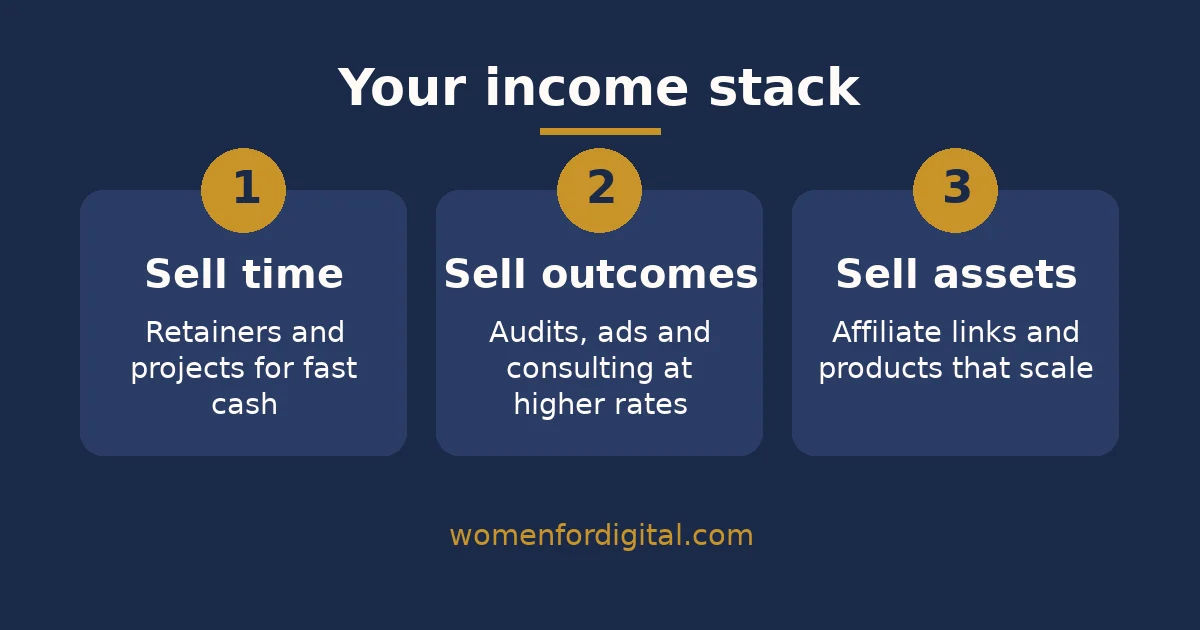
Most beginners try to jump straight to assets because they look passive. That is the most common mistake in digital marketing monetisation. Assets need an audience and a track record, and services build both. Start with time, move to outcomes, then add assets.
What Your Time Is Worth: Price Anchors and Simple Math
Pricing feels like guessing until you anchor it to something. Talent Scout’s Marketing Hiring Gap Report analysed 6,731 US marketing postings. It found median advertised salaries of $62,814 for junior roles, $87,500 for mid-level roles and $135,000 for senior roles.
Here is the arithmetic. A full-time year holds about 2,080 hours, so $62,814 works out to roughly $30 an hour. A freelancer cannot bill every hour, though, because pitching, admin and revisions take time. If only 50% to 60% of your hours are billable, you need about $50 to $60 an hour to earn the same amount.
These are American figures, so adjust them to your market. The method matters more than the number:
- Divide your target monthly income by your billable hours to find your minimum hourly rate.
- Multiply the hours a package takes by that rate to get the package price.
- Add about 20% as a buffer for revisions and back-and-forth.
Ceilings matter too. The US Bureau of Labor Statistics reports a median pay of $165,780 for advertising and marketing managers. That role needs experience, but it shows where proof of results can eventually lead.
Why You Should Negotiate
The Link in Bio survey of 2,500 social media professionals found that nearly 75% of those who negotiated got more than they were first offered. Successful negotiators earned about 15% more than those who did not. That is correlation, not a guarantee, but it is a strong reason to ask.
7 Digital Marketing Monetisation Routes, Ranked by Speed to First Payment
The order below runs from fastest cash to slowest. Every route in digital marketing monetisation has a first-client tactic and a common trap, so each section names both. Most people should start near the top and work down.
1. Social Media Management Retainers
This is the fastest route because businesses always need content and rarely have time to make it. Talent Scout found 42.2% of social media manager postings still open after 30 days, so demand is there. Budgets are tight, though, and 77% of the professionals in the Link in Bio survey reported burnout, so scope your package tightly.
First offer: 12 posts, four stories and a weekly report each month. Illustrative math, with invented numbers: if the package takes 14 hours and your minimum rate is $20, the price is $280 a month. Three clients bring in $840.
How to find the first client: start with businesses whose pages you already follow. Message the owner, mention one post that underperformed, and offer a 30-day trial at a reduced price in exchange for a testimonial. What slows it down: unclear scope, because “manage my page” can mean anything. List the deliverables in writing.
2. Paid Ads Management
Ad management pays well because it touches revenue. Talent Scout found 40.6% of media buyer postings open after a month. Charge a setup fee plus a monthly management fee, either flat or as a share of ad spend, and never promise a return on ad spend.
Ask the client to pay the platform directly from their own account. You never handle their money, and they see exactly how it is spent. Start with small budgets until you have two or three results to show.
How to find the first client: look for businesses already running ads with obvious gaps, such as no tracking or a weak offer. Offer a free 15-minute review of their account, then propose a two-week test. What slows it down: tracking. Without a conversion event set up, you cannot prove results, so fix measurement first.
3. Content and Copywriting
HubSpot’s State of Marketing survey found that 42.5% of marketers use AI extensively for content creation. Generic copy is therefore getting cheap. The premium moves to writing that is researched, specific and accurate.
Price by the project, such as a homepage, an article or an email sequence, and not by the word. First offer: a homepage rewrite with a before-and-after comparison and a short explanation of each change.
How to find the first client: approach agencies and start-ups that publish often but inconsistently. Send two headline ideas and one short sample. What slows it down: unlimited revisions. Include two rounds of edits in the price, and charge for extra ones.
4. Website and SEO Projects
W3Techs reports that WordPress runs 40.2% of all websites. Every one of those sites needs building, fixing and maintaining. Charge a project fee for the build, then offer a monthly care plan for updates, backups and basic SEO.
The care plan is the important part. It turns a one-off sale into recurring income, and it keeps you in touch with a client who may need more work later.
How to find the first client: look for businesses with slow or outdated sites. Run their homepage through Google’s free PageSpeed Insights, send the result and offer a fix. What slows it down: scope creep, so list every page and function before you quote.
5. Audits and Consulting
An audit is the bridge from selling time to selling outcomes. You review a business’s page, ads or website, then deliver a one-page plan with the five fixes that matter most. Sell it at a fixed price.
Wait until you have two or three results before you call yourself a consultant. Advice sells on track record, and a fixed-price audit is the safest way to build one.
How to find the first client: offer the audit to past clients and warm contacts first, because they already trust you. What slows it down: vague deliverables. Say exactly what the client receives: a one-page plan, the five fixes ranked by impact, and a 30-minute call.
6. Affiliate Marketing
Affiliates earn a commission when someone buys through their link. HubSpot’s affiliate programme pays 30% recurring commission for up to one year, with a 180-day cookie. Payments run through Impact, with a $10 minimum balance.
Recurring commission means each referred customer keeps paying you for months. But you need an audience first, so this route is slow for beginners. Disclose every affiliate link to your readers, because honesty protects trust and many advertising rules require it.
How to start: choose one product you have genuinely used, write an honest comparison or tutorial, and link to it. Track clicks and sales for 60 days before adding more. What slows it down: traffic. Without visitors, even a 30% commission pays nothing.
7. Digital Products and Courses
Templates, planners, swipe files and short courses turn your work into assets. Build them from what you already do for clients, such as a content calendar or a proposal template.
Pre-sell before you build. If ten people will not pay for the idea, an elegant product will not change that. Marketplaces and payment tools differ in fees, so compare the total cost before you choose one.
How to start: take the template your clients ask for most, tidy it up and offer it to ten people at a small price. Their feedback shapes version two. What slows it down: building before validating, which wastes weeks.
How to Land Your First Client in 30 Days
The first client is the hinge of digital marketing monetisation. Testimonials, referrals and higher prices all depend on that first yes, so treat the month as a project with weekly targets.
Week 1: Build Your List and Your Sample
List 20 local businesses whose customers you understand. Then create one sample that matches your chosen route, such as a 30-day content plan, a homepage rewrite or a one-page audit. A finished sample makes every later message easier.
Weeks 2 and 3: Pitch Five a Week
Keep each message short, specific and focused on one ask. For example: “Hi Sam, I noticed your last three posts got fewer than 20 likes and none had a call to action. I made a one-page plan with three fixes. May I send it over?”
That message works because it proves you looked at the business, names a problem and offers something small. Follow up twice, because many replies arrive after the second nudge.
Week 4: Close and Deliver
Propose a small paid pilot instead of a long contract. Agree the scope in writing, take 50% upfront, and deliver early. Then ask for a testimonial that includes a number, because that sentence will sell your next client.
Where the Clients Are for Digital Marketing Monetisation
Small businesses are the biggest pool of potential clients anywhere in the world. The World Bank says small and medium enterprises make up around 90% of all businesses and account for more than half of global employment.
They are also online. DataReportal counts 6.12 billion internet users worldwide, which is 73.8% of the global population, and 5.79 billion social media user identities. Those identities may not all be unique people, but the scale is clear. Your future clients’ customers already spend their time on these platforms.
My reading is that clients are plentiful but price-sensitive. Many small owners cannot afford agency rates, so a mixed approach works well. Serve one or two nearby clients at local rates for steady cash, and add a remote client in a higher-paying market for margin.
Stack Your Income: A 12-Month Sequence
Stacking beats jumping in digital marketing monetisation. Each layer funds and feeds the next one, so you do not need to wait for a big audience before you earn.
Months 1 to 3: Cash From Services
Sell one package to one or two clients. Pitch five businesses a week, and collect a testimonial with a number in it from your first client.
Months 4 to 6: Package and Raise Prices
Turn what you have done into fixed packages and one audit offer. Raise prices for new clients, because your proof has grown.
Months 7 to 12: Add Assets
Now build the slow income. Publish helpful content, add affiliate links where they genuinely fit, and turn your best template into a product. Track three numbers every month: money in, hours worked and your effective hourly rate.
How to Get Paid by Clients in Other Countries
Remote clients often pay closer to global rates, so this matters. Freelancers commonly receive foreign currency through multi-currency accounts and payment services such as Payoneer or Wise. Availability and features differ by country, so check each provider’s current rules for where you live.
Compare the total cost, not just the headline fee. Some providers build an exchange-rate margin into the conversion on top of their fees, so run the same small test transfer through two options before you commit.
Protect yourself on the client side as well. Ask for 50% upfront on projects, agree milestones in writing, and invoice in one clear currency. Keep records of every payment, because you will need them for taxes.
Mistakes That Cap Your Income
Most income ceilings in digital marketing monetisation are self-inflicted. These five come up most often:
- Charging by the hour forever. Hours cap you, while packages and outcomes let your rate rise with your skill.
- Serving everyone. A niche such as “click-to-message ads for fashion sellers” is easier to sell than “digital marketing”.
- Skipping the contract. Scope creep is the fastest way to turn a good rate into a bad one.
- Chasing assets too early. Affiliate income without an audience is a slow wait.
- Not tracking your effective rate. If a $300 project takes 30 hours, you are earning $10 an hour.
Protect Your Digital Marketing Monetisation With Simple Paperwork
Paperwork is not glamorous, but it protects your income. A short agreement stops most disputes before they start, and clients generally respect a freelancer who has one. Include these six points:
- Scope: exactly what you will deliver, and what you will not.
- Price and schedule: the total, the deposit and the due dates.
- Revisions: how many rounds are included, and what extra ones cost.
- Ownership: who owns the work once the client has paid.
- Access: which accounts the client will share with you, and how.
- Ending the work: how either side can stop, and what happens to unpaid invoices.
Keep a simple record of every invoice and payment, and set aside a share of each payment for tax. Rules differ by country, so check your local requirements or ask an accountant. This is general guidance, not legal advice.
What Doing This Right Looks Like
Four graduates of Women For Digital started digital marketing roles within weeks of finishing. One landed a job within two weeks. Another began freelance work before she finished the training, then moved into a full-time role. A third secured a full-time remote role six weeks after the course.
The programme reports that 29% of its graduates are employed before graduating, 86% within six months and 98% within 18 months. These are its own figures, not an independent audit. It also lists proposal and contract templates, value-based pricing guides, client outreach funnels and closing scripts among its resources.
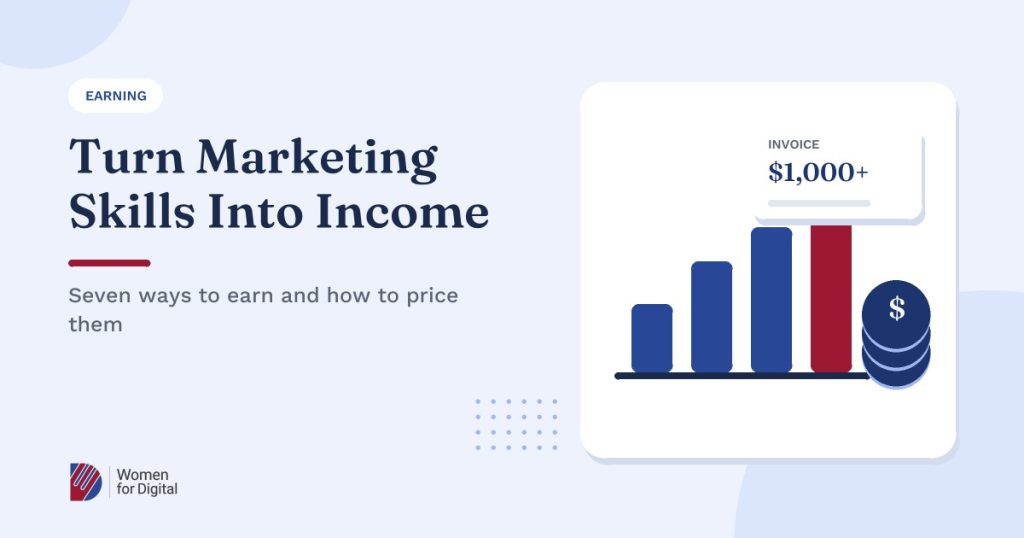
Here is an illustrative month-six picture of digital marketing monetisation, with invented numbers. A beginner has three retainer clients at $280 each, one $150 audit and $40 in affiliate commission, for $1,030 in total. None of it is passive yet, but every layer is now working.
Frequently Asked Questions About Digital Marketing Monetisation
What is digital marketing monetisation?
Digital marketing monetisation is the process of turning digital marketing skills into income. It covers services such as retainers, outcomes such as audits and consulting, and assets such as affiliate links and digital products.
How much can beginners earn from digital marketing monetisation?
It depends on your market and your proof. Talent Scout’s US postings show a median advertised salary of $62,814 for junior roles. Freelancers set their own rates, and remote clients may pay closer to global levels than local ones.
What is the fastest way to start earning?
Sell one clear package, such as a monthly social media package, to a local business. Pitch five businesses a week and follow up twice on every message.
Can you start digital marketing monetisation with no degree or experience?
Yes. Clients pay for results, and a finished sample matters more than a diploma. Google’s beginner certificate requires no degree or experience, and our guide to a digital marketing career for beginners with no degree shows seven ways in.
How long does it take to earn your first payment?
Many beginners aim for 60 to 90 days, but it depends on how soon you pitch. Training providers such as SkillUp put the full career transition at six to twelve months. A first freelance payment can come sooner if you start pitching in your second month.
Do you need an audience to earn?
Not for services. Clients pay for results, not followers. You do need an audience for affiliate income and digital products.
Is affiliate marketing worth it for beginners?
It is worth adding, but not worth starting with. Recurring commissions such as HubSpot’s 30% for up to a year can add up, yet they depend on traffic that takes time to build.
How should you price your first project?
Estimate the hours, multiply by your minimum hourly rate, and add about 20% for revisions. Raise the price after your second testimonial.
Start With One Paying Package
Digital marketing monetisation rewards people who sell one clear thing to one real customer. Write your package this week, list five businesses to pitch, and price it with the formula above. Everything else can wait.
If you are still choosing a path, read our guide to a digital marketing career for beginners with no degree. If you are unsure whether the field suits you, see is digital marketing a good career for beginners. More guides live on the Women For Digital blog.
If cost is your barrier, Women For Digital runs a fully funded scholarship for women aged 20 to 35. It covers the $235 tuition for accepted applicants, who pay a $30 commitment fee. The four-week programme offers social media and advertising or WordPress and SEO tracks, each ending in a portfolio piece, with career coaching and job search support. Read the five-step process and check whether applications are open.
Every figure in this guide was checked against its original source before publication. Figures marked as illustrative are invented examples, not real results.
Ready to begin? Visit Women For Digital today.