
Is digital marketing a good career for beginners? Yes, if you enjoy learning, testing and working with numbers. Entry-level competition is intense and most teams are not adding headcount, so pick a lane, build proof and use AI as leverage. Run a 14-day trial before you commit money or months.
Key Takeaways
- The US Bureau of Labor Statistics projects 6% growth for marketing managers and 7% for market research analysts over the next decade, both faster than average. Those are experienced roles, so the on-ramp is still your problem.
- Entry level is crowded. Indeed Hiring Lab found that 49% of recent applications from workers with 10 or more years of experience went to entry-level roles.
- AI is now the baseline. HubSpot reports that 86.4% of marketing teams use it, and most companies do not plan to add significant marketing headcount.
- Pay climbs with proof. Talent Scout’s US postings show median advertised pay of $62,814 for junior roles, $87,500 for mid-level and $135,000 for senior.
- Is digital marketing a good career for beginners? It suits people who like testing and learning, and it suits stability-seekers far less. A 14-day trial will tell you which one you are.
Is Digital Marketing a Good Career for Beginners? The Honest Short Answer
Digital marketing is not one career. It is at least three. Channel operators run social media, video and email. Performance people buy ads, run SEO and read data. Builders create websites and automations. Each group faces different pay, different competition and a different risk of burnout, so one blanket answer rarely helps.
So, is digital marketing a good career for beginners? For many people, yes. The entry cost is low, results are measurable, and there are many lanes to try. The downsides are just as real: a crowded entry level, flat headcount, AI eating routine tasks and a high burnout rate in some roles.
This guide gives you numbers for both sides, so you can judge the trade-off yourself. Then it offers eight signs that the work will suit you, three signs that it will not, and a 14-day test you can run for free.
What the Data Says About Demand and Pay
Demand Is Real, but the Growth Sits in Experienced Roles
The BLS projects that employment of advertising and marketing managers will grow 6% over the next decade, and it counts 454,800 of those jobs. For market research analysts, it projects 7%. Both rates beat the average for all occupations, which means marketing is growing faster than most fields.
There is a catch, however. The BLS says marketing managers typically need related work experience. So the growth is real, but you must earn your way to it, and that starts with an entry-level job.
Postings Stay Open Because Budgets Are Tight
Talent Scout’s Marketing Hiring Gap Report analysed 6,731 US postings across 16 marketing roles. It found that 28.9% were still open after 30 days. For social media managers the figure was 42.2%, while media buyers reached 40.6% and video editors 34.5%.
Its CEO says that is not a recruiting problem but a cost problem. My reading is that employers want this work done, but they are not always willing to pay full price for it. So expect demand to be wide and pay to be negotiable.
Pay Climbs Steeply After the First Rung
When people ask “is digital marketing a good career for beginners,” pay is usually the first worry. The same report found median advertised salaries of $62,814 for junior roles, $87,500 for mid-level roles and $135,000 for senior roles. That is a jump of about 39% from junior to mid-level, so pay rises quickly once you have a track record.
These are American figures from postings that state a salary, so treat them as a shape and not a promise. The pattern still travels, because getting the first job is the hard part and pay compounds once you have results to show.
The Case For: Four Reasons Digital Marketing Is Worth Trying
Four reasons push the answer to “is digital marketing a good career for beginners” toward yes, because each one is easy to test yourself.
The entry cost is low. Google’s Digital Marketing and E-commerce certificate requires no degree or experience. It lists more than 190 hours of instruction and practice, paced at six months and ten hours a week. Free options such as HubSpot Academy and Meta Blueprint cost nothing, so money is not a barrier to a first trial.
Results are measurable. You can test a caption, an ad or a subject line and see which one wins by the end of the week. That feedback loop builds skill faster than most careers allow, and it gives you numbers for your portfolio.
There are many lanes. Our guide to a digital marketing career for beginners with no degree covers seven entry paths. Switching between them is easy, because the core skills of testing, writing and reporting carry over.
The best channels are free to practise on. HubSpot’s survey ranks Instagram first for return on investment among B2B marketers, at 48.4%, and level with Facebook among B2C marketers, at 47.4%. YouTube and TikTok also rank highly. So you can practise on all of them today without spending anything.
The Case Against: Three Problems Worth Knowing First
A fair answer to “is digital marketing a good career for beginners” must weigh the downsides. Three matter most, and each has a practical fix.
1. The Entry Level Is Crowded
Indeed Hiring Lab’s data shows experienced workers applying for entry-level roles. In its analysis, 49% of applications from workers with 10 or more years of experience went to entry-level jobs. They accounted for 30% of all entry-level applications, and only 12% of their applications targeted senior roles.
As a result, you are competing with veterans, not just other beginners. The way through is specificity. “I run click-to-message ads for independent fashion sellers” and one result beats “I do digital marketing”.
2. Teams Are Not Growing While AI Spreads
HubSpot’s State of Marketing report surveyed more than 1,500 marketers. It found that most companies do not expect to add significant marketing headcount, while 25.7% of marketers say their workload rose significantly and 47.4% say it rose moderately. Meanwhile, 86.4% of teams use AI in at least a few areas.
The result is simple. Companies now hire people who let one person do the work of two, so show that you can test faster, report clearly and use AI tools without losing quality.
3. Burnout Is Common in Some Roles
The Link in Bio survey of 2,500 social media professionals across 40 countries found that 77% reported active or recent burnout. Only 10.3% described their workload as reasonable, while 45% were considering leaving the field. Note the limits: this survey covers social media roles, not all of marketing.
Because burnout builds slowly, protect yourself early if you choose a channel-operator path. Define your deliverables in writing, set working hours, and turn off notifications after them.
The Three Skills That Make You Hireable
HubSpot ranks the most valuable marketing skills as automation and AI prompting, cross-team communication, and data and analytics. It also lists finding candidates with the right skills as the top hiring challenge. That combination tells you where to invest.
- Automation and AI: learn one workflow end to end, such as drafting, editing and scheduling a week of posts.
- Communication: write weekly updates that a busy manager can read in 60 seconds.
- Data: learn to read reach, clicks and conversions, and to explain any change in one sentence.
Because employers struggle to find all three in one person, that scarcity is your opening. A beginner who shows every one of them in a single case study is rarer than most people think.
8 Signs Digital Marketing Is a Good Career for You
Each sign below comes with a small test. Run the test before you decide, because a real reaction beats a guess.
1. You Like Testing Ideas More Than Defending Them
Marketers are wrong often, but the good ones enjoy finding out why. Test: post two versions of the same message with different opening lines and see which one wins. If you feel curious, that is a good sign. If you feel attacked, notice that.
2. You Can Explain One Idea Clearly in Writing
Most channel work is written communication, so it is no surprise that HubSpot ranks cross-team communication among the most valuable marketing skills. Test: describe a product you love in 60 words that a stranger could act on.
3. You Stay Calm When Numbers Drop
Every campaign has bad weeks. What matters, then, is whether you can read the numbers and ask why. Test: spend 30 minutes with the analytics on any page you run, even a personal one, and write three sentences on what changed and why.
4. You Pick Up New Tools Quickly
HubSpot puts automation and AI prompting at the top of its valuable-skills list. Test: learn the basics of Canva or an AI writing tool in one weekend, then publish something made with it.
5. You Can Take Feedback Without Sulking
Clients revise, editors cut and audiences sometimes ignore your favourite post, so feedback arrives daily. Test: ask a friend to critique your work bluntly, then rewrite it. Notice how you react before you edit.
6. You Can Work Without Someone Checking In
Freelance and remote work reward routine, because nobody reminds you to publish or send the report. Test: do 45 minutes of practice every day for 14 days without being asked.
7. You Enjoy Helping Small Businesses Win
Most beginners work with small businesses first, and their wins are personal. When an owner sells out of a product because of your post, you feel it. Test: pick a local business and list three improvements to its page. If that list excites you, it is a strong sign.
8. You Can Live With Slow, Uneven Income at First
Early income is patchy, but the pay ladder is steep. In the Link in Bio survey, 51% of respondents got a raise in the past year, but only 24% got a promotion. Test: work out how many months you could cover with low or no income, and build your plan around that number.
3 Signs Digital Marketing Might Not Be Right for You
The honest answer to “is digital marketing a good career for beginners” includes the people it does not suit, so be cautious if any of these fit you:
- You want a predictable job where the tools and rules never change.
- Writing, numbers and screens all bore you.
- You need a stable salary within 60 days of starting.
None of these is a character flaw. They simply point toward a different route, or toward a slower start with a part-time plan.
What a Beginner’s Week Actually Looks Like
Most beginners picture posting all day. The real week is more varied, and knowing it helps you judge the fit. Here is a typical week for a junior person on a small marketing team:
- Monday: review last week’s numbers, then decide what to repeat and what to drop.
- Tuesday and Wednesday: write, design and schedule the week’s content, and brief any freelancers.
- Thursday: check ad spend against budget, and answer comments and messages.
- Friday: send a one-page report to the manager or client, then plan next week’s tests.
Notice the rhythm of measuring, creating, publishing and reporting. Because half the week goes on reading numbers and writing summaries, people who enjoy only the creative side often struggle. HubSpot’s survey backs this up by listing data and analytics among the top three marketing skills. If this rhythm sounds appealing, the answer to “is digital marketing a good career for beginners” is probably yes for you.
Employment or Freelancing: Which Should You Start With?
Both routes work. The right one depends on your cost of living and your tolerance for risk.
Start with employment if you need steady income, want senior colleagues to learn from, or have little savings. You will earn less per hour than a good freelancer, but you will learn faster because someone reviews your work.
Start freelancing if your costs are low, you have time to pitch, and you can name one clear niche. You keep more control, but you also carry the sales work, the taxes and the gaps between clients.
Many beginners blend the two. They keep a part-time job and add one small client, which limits the risk while they build proof. Whichever route you choose, negotiate. In the Link in Bio survey, nearly 75% of respondents who negotiated got more than their first offer, and successful negotiators earned about 15% more than those who did not.
Is Digital Marketing a Good Career for Beginners Wherever You Live?
Small businesses are the biggest pool of potential clients anywhere in the world. The World Bank says small and medium enterprises make up around 90% of all businesses and account for more than half of global employment.
They are also online. DataReportal counts 6.12 billion internet users worldwide, which is 73.8% of the global population, and 5.79 billion social media user identities. Those identities may not all be unique people, but the scale is clear. Your future clients’ customers already spend their time on these platforms.
Where you live still changes three things. Local pay comes first, because the salary figures in this guide are American and your local market may pay more or less, so check job boards near you.
Currency is second. If you serve clients abroad, you may earn in a stronger currency, so compare the total cost of each way to receive it, including fees and the exchange-rate margin. Logistics come third, since time zones, reliable internet and payment access vary.
For anyone outside the US asking “is digital marketing a good career for beginners,” the answer is yes, with logistics to plan for. Budget for connectivity, agree working hours across time zones, and set your rates in the currency your clients use.
Will AI Take Beginner Marketing Jobs?
AI changes the question “is digital marketing a good career for beginners” more than it changes the answer. HubSpot found that 86.4% of marketing teams use AI, and just 1.7% neither use it nor plan to. The heaviest use is content creation, at 42.5% extensive use, followed by media creation at 37.2%.
That hurts beginners in one specific way. First drafts, basic graphics and routine reports are getting cheap, so those tasks no longer set you apart. It helps in another way, because you can run more tests than one person could before.
So use AI for volume and use your own judgement for quality. Learn one AI tool per task, and keep a short checklist for facts, tone and brand fit before anything goes out.
A 14-Day Test: Is Digital Marketing a Good Career for Beginners Like You?
You do not have to guess. Run a two-week experiment with free tools, and let your own reactions decide.
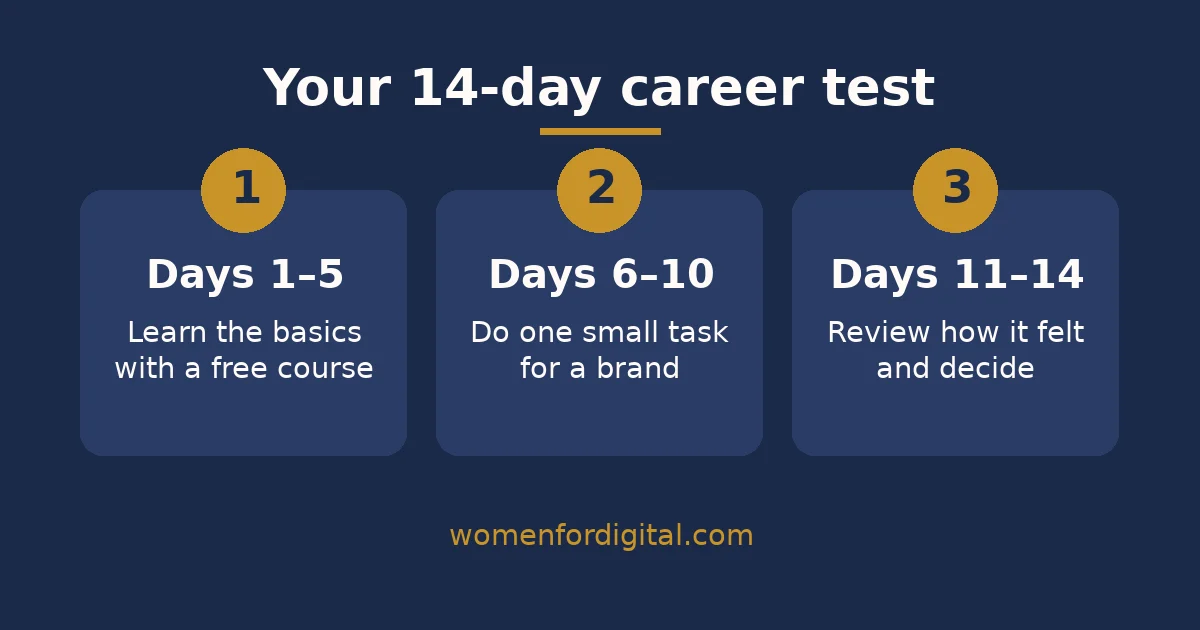
Days 1 to 5: Learn the Basics
Spend about an hour a day on one free course. Google Skillshop and HubSpot Academy both offer beginner lessons. Take notes on what you enjoyed and what dragged.
Days 6 to 10: Do One Small Task
Create a week of posts for an imaginary brand, or write one email. Then track how you felt. Did time fly, or did you keep checking the clock?
Days 11 to 14: Review and Decide
Ask three questions. Did I enjoy the work? Did I want to improve it? Could I do more of this every week? If you answered yes to two, take the next step with a longer plan. If not, you have saved yourself months.
What Doing This Right Looks Like
Four graduates of Women For Digital started digital marketing roles within weeks of finishing. One landed a job within two weeks. Another began freelance work before she completed the course, then moved into a full-time position. A third secured a full-time remote role six weeks after graduating.
The programme reports that 29% of its graduates are employed before graduating, 86% within six months and 98% within 18 months. These are the programme’s own figures, not an independent audit.
So is digital marketing a good career for beginners who get training and proof? These outcomes point to yes, with caveats. Each woman finished a real portfolio project and received coaching on her CV and interviews. Those two ingredients matter more than any credential.
Frequently Asked Questions: Is Digital Marketing a Good Career for Beginners?
Is digital marketing a good career for beginners with no experience?
Yes. Google’s certificate requires no experience, and most entry paths start with a free sample project. Structured training plus one finished case study replaces the experience employers ask for.
Is digital marketing a good career for beginners who want to work from home?
Yes. Most roles can run fully online, and freelance work is common. Remote roles attract more applicants, though, so a clear niche and portfolio matter even more.
Is digital marketing hard to learn?
The basics take weeks, and mastery takes years. The hardest parts for beginners are choosing one channel, staying with it long enough to see results, and reading data calmly.
Is digital marketing stressful?
It can be. The Link in Bio survey found 77% of social media professionals reporting burnout. Clear scopes, working hours and honest timelines with clients reduce the pressure.
How much do beginners earn?
Talent Scout’s US postings show a median of $62,814 for junior marketing roles. Local salaries in many countries are lower, while remote clients may pay closer to global rates.
Can you start digital marketing at 30 or 40?
Yes. Employers and clients care about results and reliability, and career changers bring real experience with customers, teams and deadlines. Use your previous field as a niche.
Which skill should you learn first?
Pick the one you enjoyed most in the 14-day test. Social media and content writing are the easiest to practise, and SEO and paid ads reward patience with data.
The Verdict: Is Digital Marketing a Good Career for Beginners?
So, is digital marketing a good career for beginners? Yes, when you enjoy testing and learning, and when you are willing to build proof in one lane before you branch out. It is a weaker choice if you want predictability, or if you need a full salary within weeks.
Run the 14-day test this week. If it goes well, read our guide to digital marketing monetisation to see how skills turn into income, and browse more guides on the Women For Digital blog.
If cost is your barrier, Women For Digital runs a fully funded scholarship for women aged 20 to 35. It covers the $235 tuition for accepted applicants, who pay a $30 commitment fee. The four-week programme offers social media and advertising or WordPress and SEO tracks, each ending in a portfolio piece, with career coaching and job search support. Read the five-step process and check whether applications are open.
Every figure in this guide was checked against its original source before publication. Figures marked as illustrative are invented examples, not real results.
Ready to take the first step? Visit Women For Digital today.