
Is it too late to learn digital marketing at 35? No. At 35 you are younger than the median US marketing manager, and research shows adults keep learning new skills for decades. The real limits are time, money and a crowded entry level, so plan on six to twelve months of steady practice and one strong portfolio project.
Key Takeaways
- At 35 you are below the median age of the field. US Bureau of Labor Statistics data puts the median age of marketing managers at 38.9 and of marketing specialists at 38.5.
- Your brain is not the barrier. An MIT and Harvard study of nearly 50,000 people found different mental skills peak at different ages, and vocabulary peaks in the late 60s.
- Career moves at this age are normal. A long-running BLS survey found US workers held 2.9 jobs on average between ages 35 and 44.
- Age bias is real but mostly hits later. A large NBER study found strong evidence of hiring bias against older women, especially those near retirement age, not people in their thirties.
- Time is the true cost. Google’s digital marketing certificate is paced at six months at ten hours a week, and the four people in this guide took months, not weeks.
In this guide: the honest answer, what learning research says, what labour data says, where age hurts, your advantage at 35, four real case studies, choosing your route, a six-month plan, measuring progress and FAQs.
The Honest Answer: Is It Too Late to Learn Digital Marketing at 35? No, but Time Matters More Than Age
Most answers to “is it too late to learn digital marketing at 35” say “it’s never too late” and stop there. That is kind, but not useful. They rarely show age data for the field, the research on adult learning, or real people with real timelines.
This guide fills that gap. You get the numbers on age in marketing jobs, what learning science says about adults, where age bias actually shows up, and four named people who switched careers, with what they did and why it worked.
A note on the evidence. Every statistic links to a named source, and US-only figures are labelled. Where I interpret the data, I say so. Two of the four case studies state an age, and I report only what each person published about themselves.
What Learning Research Says About Starting at 35
Different Skills Peak at Different Ages
Joshua Hartshorne of MIT and Laura Germine of Massachusetts General Hospital studied nearly 50,000 people online, plus older test data. MIT News reports that processing speed peaks around 18 or 19, while reading other people’s emotions peaks in the 40s and 50s. Vocabulary peaks in the late 60s or early 70s.
Hartshorne’s summary is the useful part: at any age, you are getting better at some things and worse at others. For marketing, that is good news. Much of the job is writing, judging what people feel and explaining ideas, which are skills that keep improving well past 35.
Adults Slow Down Because They Stop Learning, Not Because They Cannot
Rachel Wu, a psychology professor at the University of California, Riverside, wrote in Scientific American about a study in which 33 adults aged 58 to 86 learned several new skills over three months. Their memory and attention improved, and the gains held up a year later.
Wu argues that many adults spend years with few chances to learn after school and job training end. That matters for anyone asking “is it too late to learn digital marketing at 35”. The rusty feeling you may notice early on is a lack of practice, and practice fixes it.
What This Research Does Not Show
Neither study tested marketing skills. The MIT work compared different people of different ages, rather than following the same people over time. Wu’s study was small and focused on older adults. So treat both as evidence that adults can learn, not as proof that learning will be easy. My reading is that effort and routine matter far more at 35 than raw brain speed.
What the Labour Data Says About Age in Marketing
At 35, You Are Younger Than the Typical Marketer
The BLS publishes the median age of workers by occupation. In its latest annual data, the median age of marketing managers was 38.9. For market research analysts and marketing specialists it was 38.5, and for web developers 36.2. Writers and authors had a median age of 44.7.
These are US figures, and they describe who holds the jobs, not who gets hired first. Still, they undo a common myth. Marketing is not a field for 22-year-olds only, because half of US marketing managers and specialists are older than 38.
Mid-Career Job Changes Are Normal
The BLS National Longitudinal Survey of Youth followed nearly 10,000 Americans for decades. People in the group held 12.9 jobs on average from age 18 to 58, including 2.9 jobs between 35 and 44. So changing direction in your mid-thirties is common.
It is not a sign you missed your chance. Seen this way, is it too late to learn digital marketing at 35? It is simply a normal mid-career move.
You Still Have Decades of Working Life Left
Here is my own arithmetic, assuming you work until 65. Starting at 35 leaves about 30 years. Even if the switch takes a full year, you would spend more than 95% of your remaining career in the new field. So is it too late to learn digital marketing at 35? By that measure, it is early.
Where Age Does Hurt, and How to Handle It
Pretending bias does not exist would be dishonest. A resume study by David Neumark, Ian Burn and Patrick Button, published by the National Bureau of Economic Research, sent more than 40,000 applications. It found strong evidence of age bias against older women, especially those near retirement age. The key point for you is that the bias it measured was strongest far above 35.
Ageist views are also common. The World Health Organization’s report on ageism surveyed 83,034 people in 57 countries and found one in two held moderately or highly ageist attitudes.
At 35, the bigger problem is competition, not age. Indeed Hiring Lab found that 49% of applications from workers with ten or more years of experience went to entry-level roles. So you will meet other career changers in the same queue, which is why proof matters more than your birth year.
Three fixes help. Show recent, dated work, so no one assumes your skills are old. Name the tools you use, such as Google Analytics 4 or an AI writing tool. Finally, lead with results, because a number is hard to argue with.
What 35 Gives You That 22 Does Not
A 22-year-old may know the newest app. You know how customers, managers and budgets behave, and that is harder to teach. HubSpot’s State of Marketing survey of more than 1,500 marketers ranks the most valuable skills as AI and automation, cross-team communication, and data and analytics. Two of those three reward years of work.
Your past field is also a ready-made niche, and that is the best reply to anyone who asks whether it is too late. A former nurse can market health clinics. A former teacher can market courses. That niche lets you speak the client’s language on day one, which a new graduate cannot do.
Your pay ceiling is reachable too. Talent Scout’s Marketing Hiring Gap Report found US median advertised pay of $62,814 for junior roles and $87,500 for mid-level roles. With 30 years ahead, you have time to climb well past the first step.
Is It Too Late to Learn Digital Marketing at 35? 4 Real Case Studies
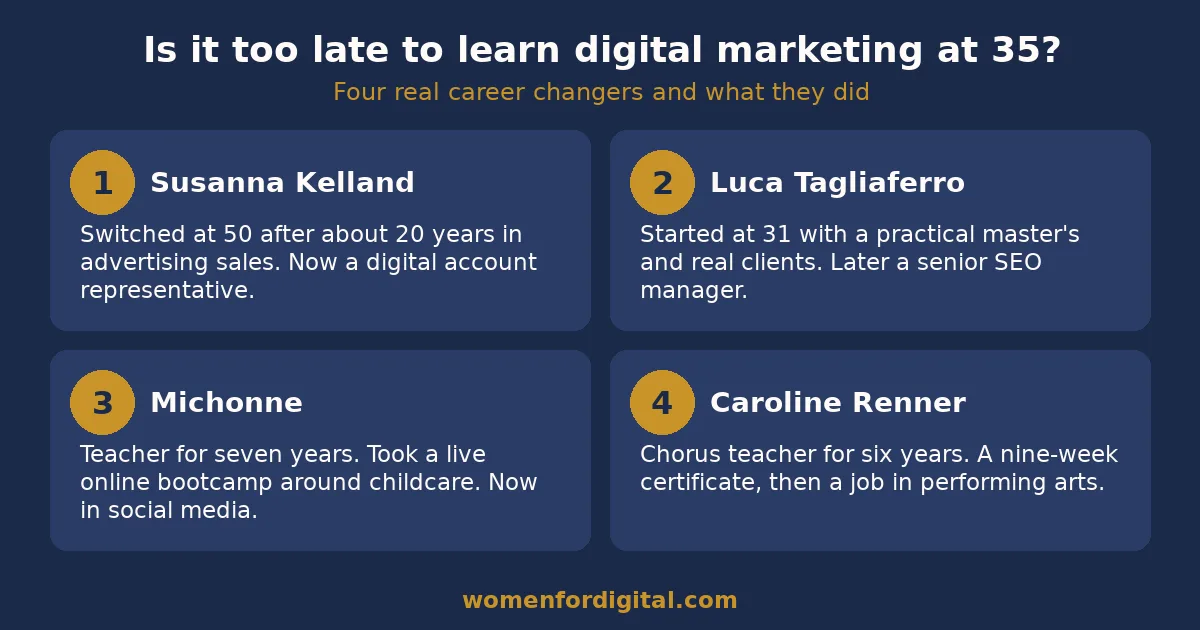
Each case below is a real, named person who published their own story. Two state their age at the switch, 31 and 50, so 35 sits between them. For each one you get what they did, what happened and why it worked.
Case 1: Susanna Kelland Switched at 50 After 20 Years in Sales
Susanna Kelland spent about 20 years in advertising sales before switching at 50. She took Google’s digital marketing certificate, a Google Analytics course and a boot camp, studying for about seven months full time. Training cost her about $894, and about $2,500 in total with equipment.
She now works as a digital account representative at Hibu. Why it worked: she chose a role that used her sales past, so her new skills sat on top of years of client work. If 50 was not too late, the answer to “is it too late to learn digital marketing at 35” is clear.
Case 2: Luca Tagliaferro Started at 31 and Became a Senior SEO Manager
Careershifters published the story of Luca Tagliaferro, who was a grants consultant in Brussels. At 31 he began a practical master’s in digital marketing that let him work with real clients. He spent four years in his first role, kept taking courses, and later became a senior manager for SEO with his own team.
Why it worked: real client projects gave him a portfolio before he graduated. His story also shows the honest timeline. The switch was fast, but the climb to senior level took years of steady work.
Case 3: Michonne Moved From Teaching to Social Media While Caring for Children
Michonne taught for seven years, four of them as head of performing arts at a secondary school, according to We Are Group’s case study. She joined a live online Skills Bootcamp in digital marketing from home, balancing it with childcare. She now works as social media and marketing executive at the Teaching Awards Trust.
Why it worked: she chose an employer in education, the field she already knew. Her new job uses Google Analytics and blog writing, so the bootcamp skills and her teaching background both count every day.
Case 4: Caroline Renner Used a Nine-Week Certificate to Leave the Classroom
Emory University reports that Caroline Renner taught middle school chorus for six years. She took Emory’s nine-week digital marketing certificate, with one live evening session a week plus self-paced work. She then became a program coordinator at Emory’s Schwartz Center for Performing Arts.
Why it worked: she searched only for roles in performing arts, where her music background was an asset rather than a gap. A short course plus a focused search beat a long course plus a scattered one.
What the Four Cases Have in Common
None of them started from zero. Each one joined new skills to an old field: sales, grants, education or music. My reading is that this pairing, more than any course, explains their results.
Their timelines differ, too. Caroline Renner’s course lasted nine weeks, while Susanna Kelland studied for about seven months. Luca Tagliaferro needed years to reach a senior role. So if you are asking "is it too late to learn digital marketing at 35", the better question is how many hours a week you can give it. The next section turns that into a rule.
How to Choose Your Route When Time Is Tight
This is the most useful rule in this guide. Choose your route by your weekly hours, not by the course with the best reviews.
- Five hours a week or fewer: use free courses, such as HubSpot Academy, and build one small project over three to four months.
- Around ten hours a week: a structured certificate fits. Google’s certificate lists 190+ hours, paced at six months at ten hours a week, and needs no degree or experience.
- Twenty or more hours a week: an intensive bootcamp or full-time study, like Susanna Kelland’s seven months, can get you job-ready faster.
Whichever route you choose, pick one channel first, such as social media, email or SEO. Learning five at once is a common reason adults quit.
Here is an illustrative example, with invented numbers. A 35-year-old office manager has eight free hours a week. She picks email, takes a free course for two months, then builds a welcome series for a local gym. Sign-ups to its trial class rise from 6 to 15 a month. For her, is it too late to learn digital marketing at 35? That one result answers it.
A Six-Month Plan If You Are Asking “Is It Too Late to Learn Digital Marketing at 35?”
This plan assumes about ten hours a week around a job or family. Keep the order, because each stage feeds the next.
Months 1 and 2: Learn One Channel
Choose the channel closest to your past work. Take one course and finish it before starting another. By the end, write a one-page summary of what you learned in plain words.
Months 3 and 4: Build One Project in Your Old Field
Run a real project for a business or charity in the field you already know. Record one starting number and one end number, such as enquiries, email sign-ups or saves. Our guide to a digital marketing career change after 30 has more project ideas.
Months 5 and 6: Apply and Pitch
Target employers and clients in your old field first, as Michonne and Caroline Renner did. Send ten tailored applications or pitches a week, and follow up once after a week.
Three Mistakes That Make 35 Feel Too Late
Most people who decide it is too late did not fail because of age. They fell into one of three traps.
- Learning everything at once. Five channels in one month feels busy but builds no proof. One channel for three months builds a project.
- Buying the most expensive course first. The US Federal Trade Commission warns that promises of guaranteed income are a red flag. Test the work with free lessons before you pay.
- Hiding your past career. Your old field is your niche. Cutting it from your CV throws away your biggest advantage.
Avoid these three, and the answer to "is it too late to learn digital marketing at 35" becomes a plan rather than a worry.
How to Measure Your Progress
Feeling slow is normal at the start. So judge your progress by numbers rather than by mood. Three measures matter most.
- Practice hours per week: the input you control. Below five, progress will feel stuck.
- Finished projects: the proof employers see. Aim for one complete project before you apply widely.
- Reply rate: replies divided by applications. A low rate usually means your project is hidden too far down your CV.
Review these every two weeks. If hours drop, shrink the plan rather than quit. A small plan you follow beats a big one you drop. This is also how you answer "is it too late to learn digital marketing at 35" for yourself: with your own data.
Is It Too Late to Learn Digital Marketing at 35, Wherever You Live?
The need for these skills is global. DataReportal counts 6.12 billion internet users worldwide, and the World Bank says small and medium enterprises make up around 90% of all businesses. Most of them need someone who can market online.
Local factors still change the maths. Pay levels vary, and the salary figures here are American. Age laws vary too: in the US, the Equal Employment Opportunity Commission enforces protection for workers aged 40 and over, but other countries set different rules. Finally, check course prices in your currency. Coursera, for example, lists financial aid for Google’s certificate.
Frequently Asked Questions: Is It Too Late to Learn Digital Marketing at 35?
Is it too late to learn digital marketing at 35 with no experience?
No. Google’s certificate asks for no degree or experience, and all four people in this guide switched from other fields. One finished project matters more than your starting point.
How long does it take to learn digital marketing at 35?
Plan on six to twelve months at about ten hours a week to be job-ready in one channel. Google paces its certificate at six months at ten hours a week.
Do I need a degree to learn digital marketing at 35?
No. Google’s certificate needs no degree, and the BLS says education for web developers ranges from a high school diploma to a bachelor’s degree. A finished project carries more weight with most small employers.
Is it too late to learn digital marketing at 35 to work as a freelancer?
No. Small and medium enterprises make up around 90% of businesses worldwide, according to the World Bank. Your past field gives you a ready list of first clients to approach.
Will employers prefer younger candidates?
Some might, but the bias found in research is strongest near retirement age. At 35 you are younger than the median US marketing manager, so recent proof matters more than age.
Which area of digital marketing is best to start at 35?
Start with the channel closest to your past work. Writers often suit content or email, while people who like numbers suit paid ads or SEO.
Can I learn digital marketing at 35 while working full time?
Yes. Ten hours a week is enough for a structured certificate, and Caroline Renner’s course met one evening a week. Keep your job until you have a project and some replies.
Is it too late to learn digital marketing at 35 if I have children?
No. Michonne balanced a live online bootcamp with childcare. Choose a course with recordings or evening sessions, and plan your hours around your family, not the other way round.
Your Next Step: Start With One Channel This Week
So, is it too late to learn digital marketing at 35? The data, the learning research and four real careers all say no. The work is to pick one channel, build one project in a field you already know, and give it six months.
For related reading, see our guides to digital marketing jobs for women with no experience, a digital marketing career change at 40 and the digital marketing career path for beginners. More guides live on the Women For Digital blog.
If you are a woman aged 20 to 35, Women For Digital runs a fully funded scholarship that covers the $235 tuition, with a $30 commitment fee for accepted applicants. The four-week programme offers a social media and advertising track or a WordPress and SEO track, each ending in a portfolio piece, plus career coaching and job search support. Read how it works and check whether applications are open.
Every figure in this guide was checked against its original source before publication. Figures marked as illustrative are invented examples, not real results.
Ready to take the first step? Visit Women For Digital today.