
A digital marketing career for beginners with no degree is realistic, but only if you replace the diploma with proof. Employers hire on a tested skill, a finished project and an easy way to reach you. Pick one of seven entry paths, build a single case study in 30 days, and start pitching before you feel ready.
Key Takeaways
- Most large employers still screen for degrees in practice. A Harvard Business School and Burning Glass Institute study found that fewer than 1 in 700 hires in the latest year studied benefited from dropped degree requirements, so start with agencies, start-ups, small businesses and freelance clients.
- Demand exists in beginner-friendly roles. Talent Scout found 42.2% of social media manager postings and 40.6% of media buyer postings still open after 30 days, although its CEO blames tight budgets more than a talent shortage.
- Seven paths suit a beginner: social media, paid social, short-form video, writing, SEO, WordPress and email. Each can produce a portfolio sample within 30 days.
- Certificates teach, but case studies get you hired. Google’s certificate is paced at six months and ten hours a week, and it still cannot replace one project with a number attached.
- The market is enormous. The World Bank says small and medium businesses make up around 90% of all businesses worldwide, and many cannot afford an agency, so a digital marketing career for beginners with no degree can start with them.
The Honest Answer: Yes, but the Degree Filter Is Real
Every guide on this topic says skills beat diplomas. Half of that is true, and the other half matters.
Harvard Business School and the Burning Glass Institute tracked 11,300 roles at large US firms over almost a decade. Only 3.6% of those roles dropped a degree requirement.
In the final year studied, the change reached fewer than 1 in 700 new hires, and 45% of the companies studied announced changes without altering how they hired. You can read the full skills-based hiring research from the Burning Glass Institute.
So a digital marketing career for beginners with no degree is possible, but it is not automatic. You have to go where the degree filter is weakest and proof carries the most weight. That means small businesses, agencies, start-ups and freelance clients.
This guide shows you seven paths into those places, what to build for each one, and a 90-day plan to follow. Expect a runway of six to twelve months from your first lesson to your first paid work, a range that training providers such as SkillUp also give. Pitching early shortens it. Waiting until you feel ready lengthens it.
Why Degree Filters Exist and Where They Fail
Degree filters exist because they are cheap. A recruiter with 300 applications for one junior role needs a fast way to shrink the pile, and a bachelor’s degree is the easiest box to tick. The US Bureau of Labor Statistics reflects that habit. It lists a bachelor’s degree as the typical entry-level education for both market research analysts and advertising and marketing managers.
But “typical” does not mean “required”. For web developers and digital designers, the same handbook says education ranges from a high school diploma to a bachelor’s degree, depending on the employer and on what you can demonstrate.
Competition adds pressure. Indeed Hiring Lab found that 49% of applications from workers with 10 or more years of experience went to entry-level roles in its latest analysis. Those experienced workers made up 30% of all entry-level applicants. You are not only competing with other beginners, so vague enthusiasm will not win the interview.
Three Doors That Open Without a Degree
Not every employer screens the same way. Aim your digital marketing career for beginners with no degree at the doors with the weakest filters first:
- Small-business and freelance clients. Nobody checks a diploma. They ask one question: can you get me customers?
- Agencies and start-ups. Many hand you a two-hour test task, which tells them more than a certificate could.
- Corporate junior roles. The degree filter bites hardest here, so treat these as a year-two target.
What Employers Hire on Instead of a Degree
Skip the degree and you must answer the hiring manager’s real question. Can this person do the job without me babysitting them? Three things answer it: a sample, a live skill and a signal. In a digital marketing career for beginners with no degree, the sample does the diploma’s job.
HubSpot’s State of Marketing survey of more than 1,500 marketers ranks automation and AI prompting, cross-team communication and data analysis as the most valuable skills. It also names finding candidates with the right skills as the top hiring challenge. In other words, employers are short on people who can prove those skills. The degree is not the proof they are missing.
The Four-Part Case Study
Your sample should be a short case study, and it should follow one structure. State the problem the business had. Describe the action you took. Show the result with a number. Then note what you would change next time.
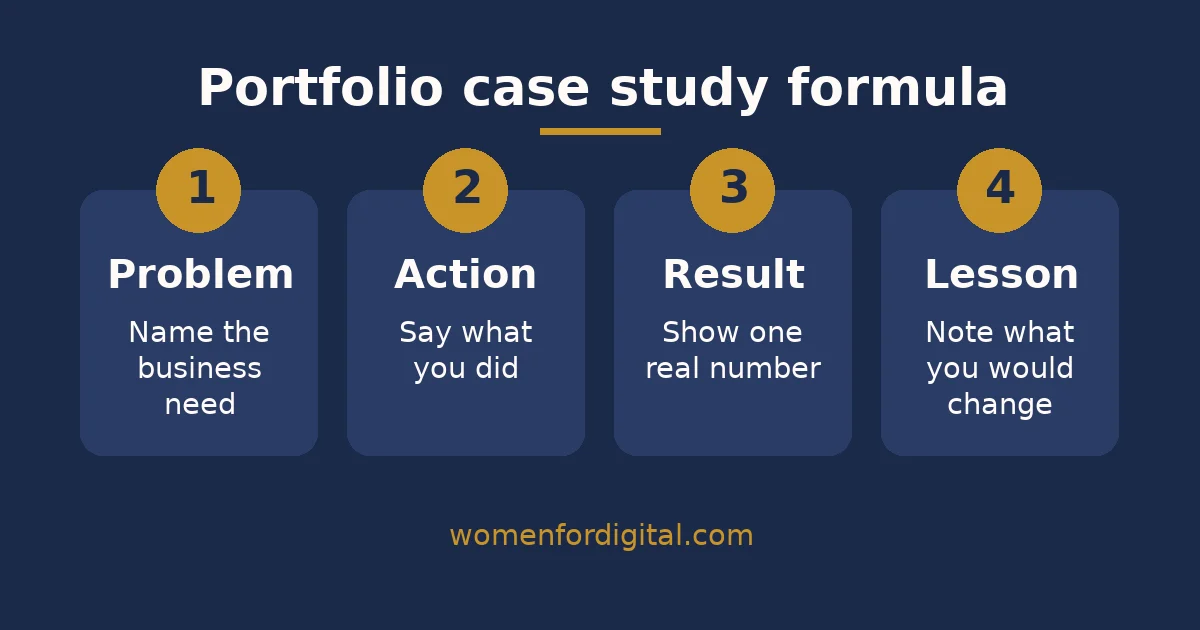
Here is an illustrative example, with invented numbers. A bakery has 400 followers and posts twice a month. You run its page for 30 days, posting four times a week and logging reach every Friday. Weekly reach climbs from 1,200 to 3,900, and the owner reports six new cake orders that mention Instagram.
That is a case study. It is small, honest and specific. If your reach had stayed flat, you would still have a lesson to write up, and a clear plan for the next test.
7 Paths for a Digital Marketing Career for Beginners With No Degree
Pick your path with three filters. Can you produce a sample in 30 days with free tools? Will a small business pay for it? And what does a beginner’s mistake cost? A weak caption costs nothing. A badly built ad campaign can burn someone’s rent money. Start where mistakes are cheap.
1. Social Media Manager
You plan content, write captions, design posts in Canva, schedule them and report what worked. Talent Scout’s Marketing Hiring Gap Report found 42.2% of social media manager postings still open after 30 days, the highest share in its US data.
Read that carefully. Its CEO calls the pattern a cost problem, not a recruiting problem, so expect modest pay. The role also carries a warning. In the Link in Bio survey of 2,500 social media professionals, 77% reported active or recent burnout. Protect yourself by selling a defined package, such as 12 posts, four stories and a weekly report, instead of “being available”.
First sample: a 30-day content test for a local business, with reach and saves logged weekly.
2. Paid Ads Assistant
Media buyers turn a budget into customers. They choose audiences, test creative and read the results. Talent Scout found 40.6% of media buyer postings open after a month. Meta Blueprint offers free courses on Meta’s ad tools, and click-to-message ads, which open a chat instead of a web page, are worth learning early in markets where customers buy through chat.
Mistakes cost real money here, so start as an assistant or test on your own small budget. First sample: a two-week campaign for a local shop, with the cost per message or per sale recorded.
3. Short-Form Video Editor
Brands need vertical clips, and most owners have no time to cut them. HubSpot’s survey ranks short-form video as the best-performing content format, chosen by 48.6% of marketers. Talent Scout found 34.5% of video editor postings open after a month.
You need a phone, a free editing app and a sharp eye for the first three seconds. First sample: three 30-second clips cut from one raw video, each with a different opening hook, compared by average watch time.
4. Content Writer or Copywriter
HubSpot found that content creation is where marketers lean on AI most, with 42.5% using it extensively. That should change how you position yourself. Generic copy is now cheap, so sell what AI cannot fake: specific details, real customer language and accurate claims.
First sample: a rewritten homepage for a local business, with before and after versions and a one-line reason for every change.
5. SEO Assistant
SEO helps a website show up when customers search. You research keywords, fix page titles, speed up pages and track results in Google Search Console, which is free. Rankings move slowly, so clients need patience and you need a reporting habit that shows progress before the rankings do.
First sample: an audit of a five-page business site. List the five fixes that matter most, make them, and record search impressions 30 days later.
6. WordPress Site Builder
W3Techs reports that WordPress runs 40.2% of all websites, and 58.8% of those with a known content management system. That is a huge pool of sites to build, repair and maintain.
The BLS puts median pay for web developers and digital designers at $99,520 in the US. Treat that as a ceiling for experienced people, not a starting salary. First sample: a five-page site for a real local business, tested on a phone and checked for page speed.
7. Email Marketing Assistant
Email is the channel a business owns. Platforms change their algorithms, but the list stays yours. Assistants write newsletters, build welcome sequences, and clean and segment contact lists. Free plans on most email tools let you practise without paying.
First sample: a five-email welcome sequence for a small shop, with subject-line variants and a one-page segmentation plan.
How to Choose Your Path in One Afternoon
Write down your top three candidates. Then ask each one three questions. Can I make a sample with what I have this month? Do I know someone who could use it? Would I still enjoy this work in week 40?
Choose the path with three yeses. If two paths tie, take the one where mistakes cost less. Any digital marketing career for beginners with no degree begins with one path, not a lifelong commitment. You can add a second skill later, and a writer who learns basic ads quickly becomes worth more than either skill alone.
Your 90-Day Plan for a Digital Marketing Career for Beginners With No Degree
A schedule beats motivation. Use this plan and adjust the pace to your life, but keep the order.
Days 1 to 30: Learn One Skill and Finish One Project
This month decides whether your digital marketing career for beginners with no degree gets a foundation or just a folder of bookmarks. Study for one hour a day, using structured lessons instead of random videos. Finish one project and write it up as a case study. Do not start a second skill until the first sample exists, because a second half-finished skill is worth nothing to a client.
Days 31 to 60: Package Your Offer and Pitch
Write your offer in one sentence: what you do, for whom, and what they get. Build a list of 20 local businesses and message five a week. Keep each message short, mention one specific thing you noticed, and link to your case study.
For a US reference point on pricing, Talent Scout’s median junior marketing salary is $62,814. That works out to about $30 an hour for a full-time employee. Local rates in many countries are lower, but remote clients often pay closer to global rates. Price your first package modestly, then raise it after two testimonials.
Days 61 to 90: Land the Work and Collect Proof
Follow up twice on every message, because most replies come after the second nudge. Apply to ten junior roles at the same time, and tailor each application to one sample. When a client says yes, deliver early and ask for a testimonial that includes a number.
By day 90 you want three things: one paid job or client, one testimonial with a result in it, and a case study you can share in a single link.
How Long Does a Digital Marketing Career for Beginners With No Degree Take to Pay?
Slower than the ads promise, and faster than a degree. Use this ladder as a realistic guide, and expect your own numbers to differ.
- Months 1 and 2: you learn one skill and finish one sample. Income is zero, which is normal.
- Months 3 and 4: you pitch, interview and take your first small paid task. Some people accept one free project here in exchange for a strong testimonial.
- Months 5 to 8: you land one to three regular clients or a junior role, provided you keep pitching every week.
- Months 9 to 12: you raise your rates and add a second skill.
The money follows results. Talent Scout’s US postings show a median advertised salary of $62,814 for junior marketing roles and $87,500 for mid-level ones, a jump of about 39%. Senior roles reach $135,000. These are American figures, but the pattern travels: the first job is the hard part, because pay compounds once you have a track record.
Free and Paid Ways to Learn the Skills
Google’s Digital Marketing and E-commerce certificate requires no degree or experience. Google lists more than 190 hours of instruction and practice, paced at six months and ten hours a week. It says 75% of graduates report a positive career outcome within six months, based on a survey of US graduates.
Treat that number with care. It is self-reported, and it counts promotions and raises as well as new jobs. It is not a hiring guarantee.
Free options cover the basics well. HubSpot Academy teaches content, email and inbound marketing, and Meta Blueprint covers ads. Use them to learn fast, then publish your project. Certificates support a digital marketing career for beginners with no degree only when a project sits beside them.
Why Small Businesses Are Your Best First Clients
Small businesses are the biggest pool of potential clients anywhere in the world. The World Bank says small and medium enterprises make up around 90% of all businesses and account for more than half of global employment.
They are also online. DataReportal counts 6.12 billion internet users worldwide, which is 73.8% of the global population, and 5.79 billion social media user identities. Those identities may not all be unique people, but the scale is clear. Your future clients’ customers already spend their time on these platforms.
My reading of these numbers is simple. Millions of small businesses already sell where their customers scroll, but many cannot afford an agency. In a digital marketing career for beginners with no degree, that gap is your first market. A beginner who runs those channels well, for a fair price, fills it.
The Real Risks of a Digital Marketing Career for Beginners With No Degree
Nobody should start this without seeing the downsides. Three matter most, and each has a practical answer.
A Crowded Entry Level
Indeed’s data shows experienced workers applying for the same junior roles you want. The answer is specificity. A beginner who says “I run click-to-message ads for independent fashion sellers” and shows one result beats ten who say “I do digital marketing”.
Tight Budgets and Burnout
Talent Scout’s CEO calls slow hiring a cost problem. The Link in Bio survey shows what that feels like from the inside, because 67.2% of respondents feel they are doing more than one job. Set the scope in writing before you start. Ask for what you are worth, too, since nearly 75% of respondents who negotiated got more than the first offer.
AI Compressing Routine Work
HubSpot reports that most companies do not plan to add significant marketing headcount, while 86.4% of teams already use AI. Routine tasks will keep getting cheaper. Learn measurement, testing and client communication, so you sell results and not hours of typing.
Mistakes That Stall a Digital Marketing Career for Beginners With No Degree
Most beginners stall for reasons they can fix. These five come up most often:
- Collecting certificates instead of results. A hiring manager cannot see your study hours, but they can see a campaign you ran.
- Learning three channels at once. Nothing reaches the sample stage, so nothing reaches a client.
- Working free with no limits. One free project earns a testimonial. Set the scope, the end date and the deliverables in writing first.
- Keeping your work private. Put every case study behind one link, and send that link in every pitch.
- Pitching everyone. Twenty well-researched local businesses beat 200 copy-and-paste messages.
What Doing This Right Looks Like
Four graduates of Women For Digital show how a digital marketing career for beginners with no degree can start. Anulika, Remilekun, Oluwaseun and Olajumoke all started digital marketing roles within weeks of finishing. One landed a job within two weeks. Another began freelancing before she completed the training, then moved into a full-time role. A third secured a full-time remote job six weeks after the course.
The programme reports that 29% of its graduates are employed before graduating, 86% within six months and 98% within 18 months. Those are the programme’s own figures, not an independent audit, so weigh them accordingly.
What did these women have in common? Each finished a real portfolio project, and each got coaching on her CV and interviews. The results followed the preparation. A degree was never part of the story.
Frequently Asked Questions About a Digital Marketing Career for Beginners With No Degree
Can you get a digital marketing job without a degree?
Yes, but choose your targets. Agencies, start-ups, small businesses and freelance clients hire on proof of work. Many large employers still filter by degree, so treat them as a later goal.
How long does it take to get your first paid work?
For a digital marketing career for beginners with no degree, training providers such as SkillUp put the full transition at six to twelve months of consistent effort. You can shorten it by pitching local businesses in your second month.
What is the easiest digital marketing skill to start with?
Social media management and content writing are the easiest to practise, because you need only a phone or laptop. They are also the most crowded, so pick a niche and prove results in it.
Is a Google certificate enough to get hired?
Not on its own. It shows you can finish a course, but employers still want a project and a result. Pair the certificate with one case study.
Can a digital marketing career for beginners with no degree pay well?
Yes, over time. Talent Scout’s US postings show median advertised pay of $62,814 for junior roles, $87,500 for mid-level roles and $135,000 for senior roles. Pay follows results and specialisation, not the diploma, though local salaries in many countries are lower.
Do you need to learn coding?
No. Most entry paths need none. WordPress and Elementor let you build pages visually, and email and ad platforms use point-and-click tools.
Will AI take beginner marketing jobs?
It is changing them. HubSpot’s survey found 86.4% of marketing teams use AI, so routine writing and design work is getting cheaper. Beginners who pair AI tools with judgement, measurement and clear communication still stand out.
Can you do this from home?
Yes. Every path in this guide can run fully online, so you can build it around family, study or another job.
Start Small, and Start This Week
A digital marketing career for beginners with no degree starts with one finished project, not a perfect plan. Pick a path this afternoon. Build the sample this month. Message five businesses next month.
If cost is the barrier to your digital marketing career for beginners with no degree, Women For Digital runs a fully funded scholarship for women aged 20 to 35. It covers the $235 tuition for accepted applicants, who pay a $30 commitment fee.
The four-week programme offers two tracks, social media and advertising or WordPress and SEO. Each ends in a portfolio piece, with career coaching and job search support. See the five-step process and check whether applications are open.
Want to compare careers first? Read our honest answer to is digital marketing a good career for beginners, or learn how each skill turns into income in our guide to digital marketing monetisation. More guides live on the Women For Digital blog.
Every figure in this guide was checked against its original source before publication. Figures marked as illustrative are invented examples, not real results.
Ready to start? Visit Women For Digital today.