
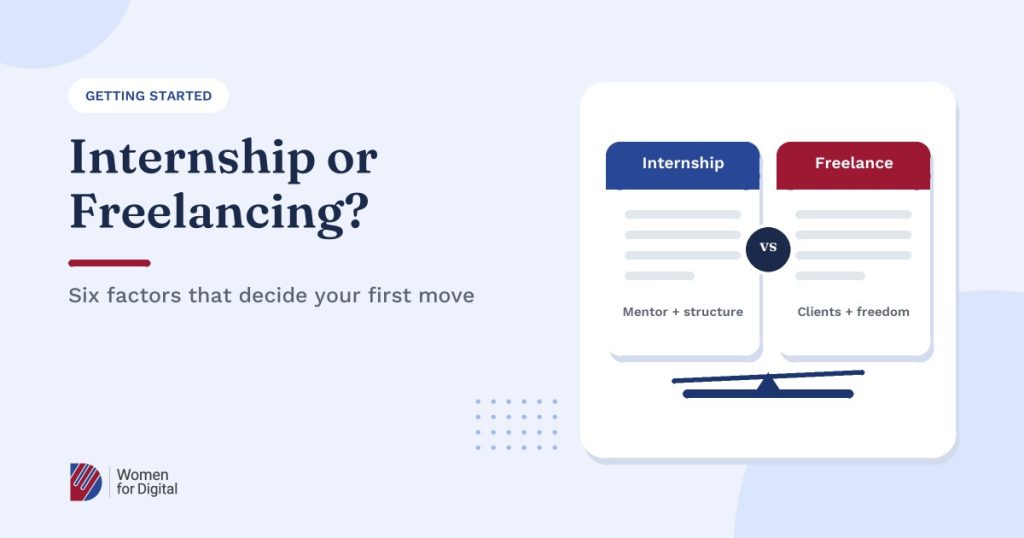
Weighing digital marketing internship vs freelancing for beginners comes down to one trade. An internship gives you structure and a mentor. Freelancing gives you speed and full control. Internships convert to job offers more often than you might think, while freelancing pays sooner and builds a portfolio you own outright, but only if you can handle uneven income from day one.
Key Takeaways
- Paid internships convert far better than unpaid ones. A National Association of Colleges and Employers (NACE) survey of bachelor’s degree graduates found paid interns at for-profit companies received offers 72.2% of the time, against 43.9% for unpaid interns. An unpaid internship is not automatically the safer choice.
- Employers still extend real offers to interns. In NACE’s most recent employer survey, covering 247 organizations, the average intern-to-full-time conversion rate reached 63.1%, and employers extended offers to 62% of their intern class.
- Freelancing is now a mainstream path, not a fallback. MBO Partners counts 27.7 million full-time independent workers in the United States, 16.7% of the national workforce, from a survey of 6,575 residents.
- Freelancing pays off in happiness before it pays off in cash. Only 52% of full-time independents in that survey report earning more than they did on payroll, yet 84% report being happier with their work.
- Marketing hiring is tight either way. Talent Scout’s Marketing Hiring Gap Report found 28.9% of US marketing postings were still open after 30 days. Both routes need a portfolio strong enough to beat that bottleneck.
The Honest Answer: Digital Marketing Internship vs Freelancing for Beginners Has No Single Winner
Most advice on this topic picks a side and defends it. That is a mistake. The two paths solve different problems.
An internship solves the problem of not knowing how a business runs. You get a manager, a process to follow, and colleagues who catch your errors before a client does. Freelancing solves a different problem. You decide what you work on, you keep every dollar a client pays, and you build a body of work with your own name on it.
The NACE data above shows why this is not a coin flip. A paid internship at a for-profit company converts to an offer 72.2% of the time. An unpaid one converts only 43.9% of the time. The gap in starting pay between those two groups runs into five figures.
So the real question inside digital marketing internship vs freelancing for beginners is not which path sounds more appealing. It is which one matches how you learn, what you can afford while you build proof, and how much risk you can absorb this year.
This guide breaks that decision into six factors, gives you a sourced number for each, and ends with a 90-day plan. That way you are not still deciding a year from now.
Why the Two Paths Test Different Skills
An internship and a freelance client test different muscles, and that is the root of most confusion around digital marketing internship vs freelancing for beginners. An internship tests whether you can follow a process, take feedback and work inside someone else’s system. A freelance project tests whether you can find the client, scope the work, deliver it alone and collect payment.
Both muscles matter eventually. HubSpot’s State of Marketing survey of more than 1,500 marketers ranks automation and AI prompting, cross-team communication and data analysis as the most valuable skills in the field today. It also names finding candidates with the right skills as the top hiring challenge employers face.
An internship builds the communication muscle first, because you practice it daily with a team. Freelancing builds the delivery muscle first, because no one else will write the report for you.
Which Muscle Should You Build First?
Neither muscle is optional for long. A hiring manager reading your CV two years from now will want proof of both, so treat digital marketing internship vs freelancing for beginners as a sequencing question rather than a permanent label. Most people who build a durable career end up doing some version of both, just in a different order.
That order is what the rest of this guide helps you choose. Read the six factors below as a checklist, not a debate, and mark which side of each one describes you right now.
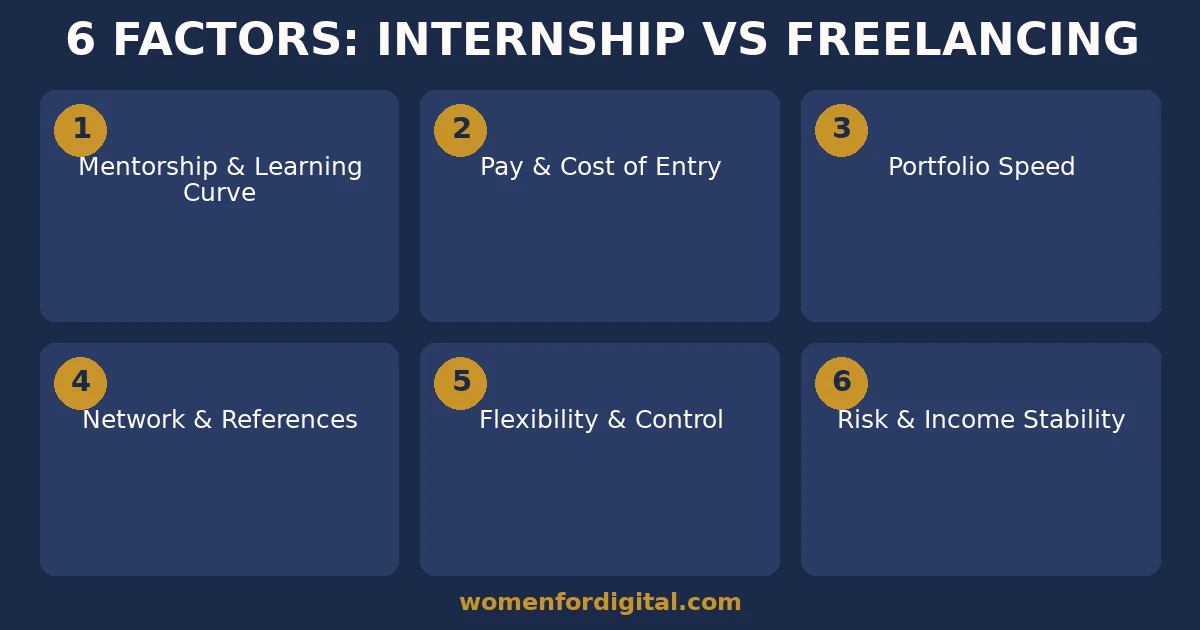
The Six Factors That Decide Digital Marketing Internship vs Freelancing for Beginners
Score yourself honestly on these six factors before you commit months to either path. Each one carries a number, a tactic and a trap. Add up how many favor structure against how many favor speed, and you have a working answer to digital marketing internship vs freelancing for beginners before you reach the FAQ.
1. Mentorship and the Learning Curve
An internship pairs you with people who have already made the mistakes you are about to make. A freelance beginner learns the same lessons alone, usually after losing a client or underpricing a project.
NACE’s conversion data hints at why mentorship matters. Employers extended offers to 62% of their most recent intern class. Most interns leave with direct, recent proof that a professional team trusted their work. Freelancing offers no equivalent stamp. Every client relationship is a smaller version of the same test, run without a coach in the room.
Trap to avoid: treating an internship as passive observation. Ask for a task with a measurable result in your first two weeks, or the mentorship advantage goes to waste.
2. Pay, Cost of Entry and Time to First Dollar
Freelancing can pay from week one. An internship, especially an unpaid one, can cost you months of living expenses before any income arrives.
NACE’s research on paid versus unpaid internships found that unpaid interns at for-profit companies who later received an offer started at a median salary of $34,375. Paid interns in the same study started at $53,521. That gap compounds, because the paid group also converted to an offer at a much higher rate.
On the freelance side, Talent Scout’s data on advertised marketing salaries puts junior in-house roles at a median of $62,814. Use that as a benchmark for pricing early freelance packages, even though freelance rates vary far more than salaried pay. Beginners in a digital marketing internship vs freelancing for beginners decision often underprice their first freelance package against this number by half or more.
Trap to avoid: taking an unpaid internship on the assumption that exposure replaces a paycheck. Ask directly about conversion history before you accept an unpaid offer.
3. Portfolio Speed and Ownership
An internship portfolio piece often belongs to the employer’s brand, and you may need permission to show it later. A freelance project belongs to you the moment the client approves it.
This is where digital marketing internship vs freelancing for beginners gets personal. Say you need a fast, sharable case study. One paying freelance client who lets you publish results will usually beat a twelve-week internship that ends in a single slide you cannot reuse. Say you want a portfolio piece backed by a recognizable company name instead. The internship wins that comparison, even if the work itself is smaller.
Trap to avoid: finishing either path with nothing you are allowed to show publicly. Negotiate what you can share before you start, not after you finish.
4. Network, References and Future Offers
A manager’s reference carries weight that a client testimonial does not always match, particularly with larger employers who still lean on formal channels to hire.
NACE’s employer survey found that paid interns averaged 1.61 job offers after graduation. Unpaid interns averaged only 0.94. That gap reflects the strength of a formal reference and an internal referral. Freelancing builds a different kind of network. Five happy clients can refer five more clients, but that chain breaks the moment you stop delivering. An internship reference, by contrast, tends to hold value for years.
Trap to avoid: leaving an internship without asking your manager directly for a recommendation that names a specific result you produced.
5. Flexibility and Control Over Your Time
Freelancing wins this factor outright. You set your hours, choose your clients and can shape the work around childcare, another job or study.
That freedom shows up in the MBO Partners State of Independence report. Only 52% of full-time independents report earning more than they did in payroll work. Yet 84% report greater happiness with the work itself. An internship runs on someone else’s clock instead, usually full-time hours for a fixed term, with little room to adjust once you have committed.
Trap to avoid: mistaking flexibility for an easy schedule. Independent workers often report working hours just as long as employees, because finding the next client is unpaid work too.
6. Risk and Income Stability
An internship, paid or not, has a defined end date and a predictable weekly amount. Freelance income moves in waves, and the first wave can take longer to arrive than beginners expect.
Talent Scout’s report found 28.9% of US marketing postings were still open after 30 days and 9.6% after 45 days. Its CEO attributes that gap to tight budgets rather than a lack of candidates. That climate cuts both ways.
It makes internships and junior roles harder to land quickly. It also means freelance clients are watching their budgets closely, so price your work so a cautious buyer can still say yes.
Trap to avoid: quitting other income before you have one repeat freelance client or a signed internship offer in hand.
How to Decide Digital Marketing Internship vs Freelancing for Beginners in One Afternoon
If the six factors still leave you undecided, use a simple scoring exercise. Give yourself one point for each factor where structure, mentorship and a recognizable reference matter more to you than speed and control. Give yourself one point on the other side for each factor where fast income, ownership and flexibility matter more.
Five or six points on the internship side means you should prioritize internship applications this month. Five or six points on the freelance side means you should spend this week pitching clients instead. A near-even split is common, and it has one honest answer: run both searches at once for 30 days, then commit fully to whichever one produces a real offer first.
This scoring exercise will not feel scientific, and it is not meant to. Its job is to turn a vague feeling about digital marketing internship vs freelancing for beginners into a decision you can act on this week, instead of a debate you keep having with yourself.
A 90-Day Plan for Digital Marketing Internship vs Freelancing for Beginners
Whichever way your score leans, use a plan instead of an open-ended search. The structure below works either way, with one branch point in month two.
Days 1 to 30: Build One Proof Point
Pick a single skill, whether that is short-form video, paid social or WordPress. Finish one project. Interns should ask for a task with a measurable outcome. Freelancers should complete one project for a friend, a family business or a low-cost first client, then log the result with a real number.
Days 31 to 60: Apply and Pitch in Parallel
Apply to five internships a week. Message five prospective freelance clients a week too, even if you plan to pick one path eventually. Comparing real responses from both routes tells you more about your market than any single article can, including this one.
Days 61 to 90: Commit to the Path That Is Converting
By day 90, one path should show more traction, either interview requests for internships or a paid trial project for freelancing. Commit your full attention to whichever one is converting. Treat the other as a backup skill to revisit later.
Mistakes That Waste Either Path
These five mistakes show up constantly in digital marketing internship vs freelancing for beginners stories that end in frustration. Each one is easy to avoid once you can name it.
- Picking based on prestige alone. A well-known company name matters less than whether the role gives you a task you can measure and show.
- Undercharging as a freelancer to get started. A rate so low it cannot cover your time teaches clients to expect it permanently.
- Treating an internship as a guaranteed job offer. Even in a strong year, NACE’s data shows offer rates well under 100%, so keep applying elsewhere while you intern.
- Freelancing with no financial cushion. Income arrives in waves, so start while you still have another source of money, even a part-time one.
- Never comparing notes with peers. Rates, offer terms and red flags travel fast through a small network, so going in blind costs you money on both paths.
Where You Live Changes the Digital Marketing Internship vs Freelancing for Beginners Math
The numbers above come mostly from US data, because that is where the largest, most detailed surveys exist. Your own market will differ. Check three things before you choose between an internship and freelancing.
First, local pay for junior marketing roles varies enormously by country and currency. Treat the US figures here as a reference point, not a target. Second, freelancing across borders usually means being paid in a currency other than your own. Compare the total cost of any payment provider, including its exchange margin, before you agree a rate with an international client.
Third, remote internships and remote freelance work both widen your options beyond your local job market. DataReportal counts 6.12 billion internet users worldwide, 73.8% of the global population. Most of the businesses you could work for, intern at or freelance for are already online.
Time Zones and the Global Client Pool
Time zones matter too once you freelance across borders. A four-hour overlap with a client’s working day is usually enough for a video call and same-day replies. Pick clients in that window before you chase every market at once. Remote internships raise a similar question. Confirm whether meetings happen live or asynchronously, because a fully live schedule across a large time difference is hard to sustain for a full term.
The World Bank puts small and medium enterprises at around 90% of all businesses globally, and more than half of global employment. Many of those businesses cannot afford a full internship program, but they can afford one freelance project.
That is worth remembering if local internships are scarce where you live. It is one more reason digital marketing internship vs freelancing for beginners tilts toward freelancing in thinner job markets.
What Doing This Right Looks Like
Graduates of Women For Digital show both routes working. According to the programme’s own figures, 29% of graduates are employed before they finish the course, 86% within six months and 98% within eighteen months. Those numbers come from the programme itself rather than an independent audit, so weigh them as a self-reported outcome, not a guarantee.
One graduate, Olajumoke, began freelancing before she had even completed her training. She then moved into a full-time role once she had a portfolio and client results to show. That sequence matches the six-factor logic above. She used freelancing for portfolio speed and income sooner, then converted that proof into the stability of full-time work.
Another graduate, Oluwaseun, secured a job within two weeks of finishing. That result lines up with the mentorship-and-reference logic behind a more structured route into a first role. Neither graduate treated digital marketing internship vs freelancing for beginners as a permanent identity. Both used whichever route produced proof fastest, then let that proof open the next door.
Frequently Asked Questions About Digital Marketing Internship vs Freelancing for Beginners
Is an internship or freelancing better for a total beginner?
Neither is universally better. An internship suits you if you want mentorship and a recognizable reference. Freelancing suits you if you need income sooner and want to own your portfolio outright. Score yourself on the six factors above before choosing.
Can you do a digital marketing internship and freelance at the same time?
Often yes, if your internship contract allows outside work and the hours do not overlap. Many beginners freelance evenings and weekends during an internship to build a portfolio piece they fully own.
Do unpaid digital marketing internships lead to job offers?
Sometimes, but at a much lower rate than paid ones. NACE’s research found unpaid interns at for-profit companies received offers 43.9% of the time, against 72.2% for paid interns. Ask about conversion history before accepting an unpaid role.
How much can a beginner freelancer expect to earn?
Very little in the first month, and a growing amount after that if you deliver results and ask for referrals. Price your first package modestly, then raise your rate once you have two or three testimonials with numbers attached.
Is freelancing too risky for someone with no savings?
It is riskier than a salaried internship, because income arrives in waves rather than on a fixed schedule. Keep another income source running until you have at least one repeat client before freelancing becomes your only income.
Which path builds a stronger portfolio faster?
Freelancing usually builds a public, shareable portfolio faster, because you own the work and client permission is often easier to get than a large employer’s. An internship can produce stronger proof if the company name carries weight in your market.
Does a digital marketing internship need a degree?
Not always. Many internships, especially at small businesses and start-ups, hire on demonstrated skill and a portfolio sample rather than a specific qualification. That mirrors how freelance clients hire too.
Which pays better long-term, an internship or freelancing?
Freelancing usually has the higher ceiling once you have a full client roster, because you keep the margin an employer would otherwise take. An internship has a lower ceiling but a more predictable floor, which matters more in your first year than in your fifth.
Choose the Path That Fits This Season of Your Life
Digital marketing internship vs freelancing for beginners is not a lifetime choice. It is a decision for the next three to six months, based on how much structure you need, how fast you need income and how much risk you can absorb right now.
If you want a fully funded way to build real skills and a portfolio piece before you choose either path, Women For Digital runs a scholarship for women aged 20 to 35. It covers the $235 tuition for accepted applicants, who pay a $30 commitment fee. The four-week programme offers two tracks: social media and advertising, or WordPress and SEO.
Every track ends with a portfolio piece plus career coaching and job search support, so you leave with proof for either an internship application or your first freelance pitch. See the five-step process and check whether applications are open.
Want more on starting without traditional credentials? Read our guide to a digital marketing career for beginners with no degree, or see the digital marketing career path for beginners for what comes after your first internship or client. More guides live on the Women For Digital blog.
Every figure in this guide was checked against its original source before publication. Figures marked as illustrative are invented examples, not real results.
Ready to start? Visit Women For Digital today.