
Here is how to restart a career after a career break in marketing: audit what changed, refresh one skill, build one recent result and explain the break in one calm sentence. Then choose a route back, such as a returnship, freelance work or a direct application. Most returners need about 90 days of focused preparation before interviews start to convert.
Key Takeaways
- A break is normal. LinkedIn surveyed nearly 23,000 workers and found 62% had taken a career break, while only 20% of hiring managers said they would reject a candidate who had one.
- Explaining the break pays. LinkedIn found 51% of hiring managers are more likely to contact a candidate who gives context, so silence is the real risk.
- The tools changed more than the craft did. Google Analytics 4 has replaced Universal Analytics, and HubSpot found 86.4% of marketing teams now use AI in at least a few areas.
- Returnships work for experienced people. iRelaunch reports that about 80% of returnship participants are hired when the programme ends.
- Your experience is an asset. The US Bureau of Labor Statistics says marketing manager roles typically need related work experience, which a returner already has.
In this guide: the honest answer, why breaks hurt, what changed, seven steps, your CV, three routes back, a 90-day plan, measuring your search, real cases and FAQs.
The Honest Answer: How to Restart a Career After a Career Break in Marketing Depends on Recency, Not the Gap
Most advice on returning to work is generic. It tells you to update your CV, network and feel confident. That is fine, but it misses the problem specific to marketing: the tools move fast, and employers want proof that you can use today’s versions.
So learning how to restart a career after a career break in marketing is mostly about recency. The gap itself matters less than whether you can show recent, relevant work. This guide shows what changed, what did not, and seven steps to close the distance.
A note on the evidence. Every statistic comes from a named, linked source, and US-only figures are labelled. Where I interpret the data, I say so. Returner outcomes vary by country, seniority and the length of the break, so treat timelines as ranges.
Why a Career Break Hurts in Marketing, and Why It Hurts Less Than You Fear
Recruiters use recent experience as a shortcut. It suggests you know the current platforms, the current metrics and the current pace. A gap removes that shortcut, so the recruiter has to work harder to trust you, and many will not bother.
The fear is usually bigger than the filter, though. When LinkedIn launched its career break feature, it surveyed nearly 23,000 workers and more than 7,000 hiring managers. It found 62% of workers had taken a break, and only 20% of hiring managers would reject a candidate with one.
The same survey found 56% of workers gained or improved skills during a break. That data is self-reported, and LinkedIn had a feature to promote. Still, it points in a clear direction: the break is rarely the deal-breaker. Unexplained, out-of-date experience is.
Where Experienced Returners Have the Edge
You are not a beginner, and you should not apply like one. The US Bureau of Labor Statistics says advertising, promotions and marketing manager roles typically need related work experience. It projects 6% growth in those jobs over the next decade, with a median US salary of $165,780.
Your years in marketing already answer the experience question. Your job now is to answer the recency question, which is much easier to fix.
What Changed in Marketing While You Were Away, and What Did Not
A good refresh starts with an honest audit. Some things you knew still work. Others have been replaced, and pretending otherwise in an interview costs you trust.
Measurement Moved to Google Analytics 4
Google states that Google Analytics 4 has replaced Universal Analytics, and standard Universal Analytics properties no longer process data. GA4 counts events and engaged sessions rather than the old pageview model. If your last reports came from Universal Analytics, this is your first refresh priority.
AI Is Now Part of Daily Marketing Work
HubSpot’s State of Marketing survey of more than 1,500 marketers found 86.4% of teams use AI in at least a few areas. The same survey ranks automation and AI prompting as the most valuable marketing skill. Expect interview questions about how you would use AI safely.
Search Now Shows AI Summaries
A Pew Research Center study of 900 US adults found about 18% of their Google searches produced an AI summary. Users clicked a traditional result in 8% of those visits, compared with 15% when no summary appeared. So organic traffic now behaves differently, and SEO reporting has to explain why.
Short-Form Video Became the Leading Format
HubSpot’s survey found marketers rate short-form video as their best-performing content format, chosen by 48.6%. If your past work centred on print, long blog posts or display ads, learn how brands plan and measure short vertical clips. You do not need to edit video yourself, but you should know how to brief it.
What Did Not Change
Knowing your customer, writing a clear message and proving return on spend still decide who gets hired. HubSpot ranks cross-team communication and data skills second and third. Those are exactly the skills a returner with years of experience can show, so lead with them.
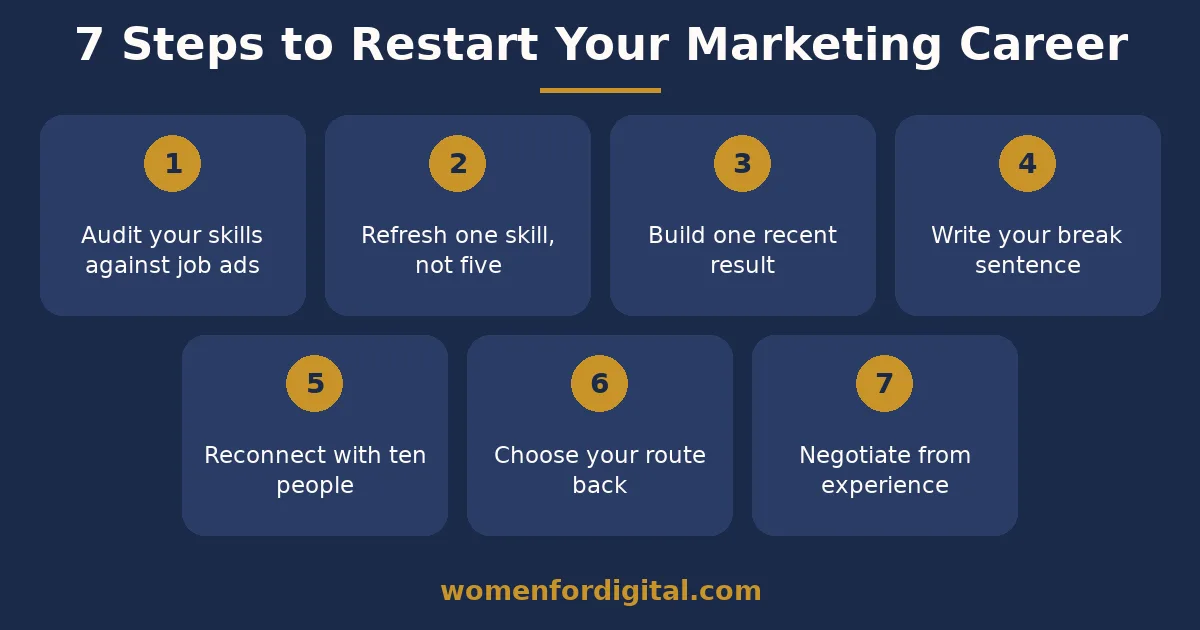
How to Restart a Career After a Career Break in Marketing: 7 Steps
These steps show how to restart a career after a career break in marketing in a fixed order: audit, refresh, prove, explain, then apply. Skipping ahead to applications is the most common mistake, because an application without recent proof hits the same recency filter every time.
Step 1: Audit Your Skills Against Current Job Ads
Collect ten job ads for the role you want. List every tool and skill they mention, then mark each one as current, rusty or new. The new column becomes your refresh plan, and it is usually shorter than you expect.
Step 2: Refresh One Skill, Not Five
Pick the gap that appears most often in the ads, which for many returners is GA4 or AI tools. Free courses on Google Skillshop and HubSpot Academy cover both. Finish one before you start another.
Step 3: Build One Recent Result
This is the heart of how to restart a career after a career break in marketing. Run a small project for a charity, a friend’s business or your own side idea, and record a before-and-after number. A result from the last three months beats ten results from before the break.
Here is an illustrative example, with invented numbers. A former brand manager sets up GA4 for a local charity, fixes its donation page and reports a rise from 12 to 31 online gifts a month. That single case study proves she can use today’s tools.
Step 4: Write Your One-Sentence Break Story
Use three parts: what you did, how you stayed current and what you want next. Here is an illustrative example, not a real person: “I took four years out to care for my family, completed GA4 and AI training, and I am now looking for a content marketing lead role.”
LinkedIn found 51% of hiring managers are more likely to contact a candidate who explains a break. Add the break to your profile, then practise the sentence until it sounds calm.
Step 5: Reconnect With Ten People
Message ten former colleagues, clients or managers. Tell them you are returning, name the role you want and ask one specific question. Warm contacts often know about roles before they are advertised, and they already trust your work.
Step 6: Choose Your Route Back
Decide between a returnship, freelance or interim work, and a direct application. Each route suits a different life, and the next section compares them.
Step 7: Negotiate From Your Experience
Do not accept a junior salary by reflex. In the Link in Bio survey of 2,500 social media professionals, nearly 75% of those who negotiated got more than the first offer. Know the local salary range for your level before the call.
How to Restart a Career After a Career Break in Marketing on Your CV and LinkedIn
Your CV has one job: get a recruiter past the recency question in six seconds. Put a short profile at the top that names your specialism, your years of experience and your recent result. Then list the break as its own dated entry with one plain line of explanation.
Under the break, add what you did to stay current, such as courses, volunteer campaigns or freelance projects. On LinkedIn, use the career break option and add the same details. Hiding the gap with clever formatting rarely works, because recruiters check dates first.
Finally, rewrite your old achievements with numbers. For example, “managed social media” says little. “Grew email revenue by a fifth in one year” says a great deal, even if the result is from before your break.
Three Routes: How to Restart a Career After a Career Break in Marketing Your Way
The right route depends on how long you were away, how senior you were and how much certainty you need. Treat the three routes below as options, not a ranking.
Returnships: Built for Experienced People After Long Breaks
A returnship is a paid, fixed-term programme for professionals coming back after a long break. iRelaunch, which advises employers on these programmes, reports that about 80% of participants are hired when the programme ends. It also says returnships make up about 80% of employer re-entry programmes.
Access is the limit. iRelaunch’s CEO, Carol Fishman Cohen, estimates that about 12% of the Fortune 500 and more than 30% of the Fortune 50 offer such programmes, according to a University of Washington article. So most are at large employers, and places are competitive.
Freelance and Interim Work: Built for Speed and Control
Short contracts give you recent experience quickly, and you control the hours. They also carry more uncertainty, because you sell your own work and chase payments. For many returners, one small contract is the fastest way to fill the recency gap on a CV.
Direct Applications: Built for Short Breaks
If your break was a year or two and your skills are fairly current, apply directly. Lead with your recent result and your break sentence. Demand is there for some roles: Talent Scout’s Marketing Hiring Gap Report found 28.9% of US marketing postings still open after 30 days.
A Decision Rule for Choosing Your Route
This is the most useful rule in this guide. Break longer than three years and senior before it? Try returnships first. Need income or flexibility soon? Start with freelance or interim work. Break under two years with current skills? Apply directly. When two answers fit, start with the route that gives you recent proof fastest.
That single choice shapes how to restart a career after a career break in marketing more than any course does.
A 90-Day Plan for How to Restart a Career After a Career Break in Marketing
This plan assumes about ten hours a week. Move faster if you can, but keep the order, because each phase feeds the next.
Days 1 to 30: Audit and Refresh
Complete the job-ad audit in the first week. Spend the rest of the month on one refresh course, such as GA4 or an AI tool for your specialism. Message five of your ten contacts before the month ends.
Days 31 to 60: Prove and Explain
Build your recent result for a charity, a friend’s business or a small paid client. Write it up as a one-page case study with the starting number, what you did and the result. Update your CV and LinkedIn profile around it, and practise your break sentence out loud.
Days 61 to 90: Apply and Negotiate
Apply through your chosen route every week and track the four funnel numbers below. Follow up once on every application after a week. When an offer arrives, negotiate from your experience rather than from your gap.
How to Measure Your Return Like a Campaign
You measured campaigns for a living, so apply the same discipline to how to restart a career after a career break in marketing. Four numbers tell you where the process is leaking.
- Applications and pitches sent: your weekly volume. Aim for a steady number, not bursts.
- Response rate: replies divided by applications. A low rate usually means your CV or targeting is off.
- Interview rate: interviews divided by replies. A low rate often points to your break story or your proof.
- Offer rate: offers divided by final interviews. A low rate suggests a skills gap or a salary mismatch.
Read them like a funnel, because that is how to restart a career after a career break in marketing without guessing. If replies are healthy but interviews stall, fix your break sentence. If nobody replies, rewrite the top third of your CV around your recent result. Change one variable at a time, just as you would in an A/B test.
Mistakes That Slow Down a Return to Marketing
Most returners who stall make one of these four mistakes. Each one has a quick fix.
- Apologising for the break. It signals doubt. State it once, then move to your result.
- Applying far below your level. Indeed Hiring Lab found 49% of applications from workers with ten or more years of experience went to entry-level roles, so the junior pool is crowded with people like you.
- Describing old tools as current. Interviewers notice when you talk about tools that no longer exist. Say what you used then and what you use now.
- Waiting until you feel ready. Confidence usually follows the first interview, not the other way round.
How to Restart a Career After a Career Break in Marketing, Wherever You Live
Knowing how to restart a career after a career break in marketing also means knowing your local market, because returning works differently across countries. Returnships are most common at large multinational employers, so your options depend on who hires near you or remotely. Freelance work travels better, because the World Bank says small and medium enterprises make up around 90% of businesses worldwide.
Three local factors matter most. Salary ranges differ, and the US figures above are ceilings for comparison, not targets. Legal protections for career gaps and age vary by country. Finally, childcare costs decide how many paid hours make the return worthwhile, so run those numbers before you commit.
What Doing This Right Looks Like
Career Returners, a UK organisation that supports people back into work, publishes named returner stories. Two show different routes into marketing and media.
Jumana Kapadia spent six years at Merrill Lynch, then took a nine-year break after having her first child. During the break she upskilled and ran her own food business. She returned through the BlackRock returner programme into investment and product content marketing, and says the skills from her business were “relevant and transferable”.
Angela, a former chief data officer, took a three-year break after serious personal and health challenges. She eased back through interim and short-term consultancy contracts, then paid for one-to-one coaching. She landed a full-time data role at Kinesso, a media company, and later became Global Operations Director.
Why did both returns work? Each one built recent, visible work before the big decision: a structured programme for Jumana, short contracts for Angela. My reading is that the route mattered less than the proof. That is the core of how to restart a career after a career break in marketing.
Frequently Asked Questions on How to Restart a Career After a Career Break in Marketing
How long does it take to restart a marketing career after a break?
For most people, how to restart a career after a career break in marketing takes about 90 days to audit, refresh and build one recent result. Landing a role can take longer, depending on your level, your local market and how many applications you send each week.
How do I explain a career break in a marketing interview?
Use one sentence: what you did, how you stayed current and what you want next. LinkedIn found 51% of hiring managers are more likely to contact candidates who explain a break.
Is a returnship worth it for marketers?
For experienced marketers after a long break, often yes. iRelaunch reports that about 80% of returnship participants are hired, although places are limited and mostly at large employers.
Which marketing skills should I refresh first?
Start with the gap that appears most often in current job ads. For many returners that means Google Analytics 4 and AI tools, which HubSpot ranks as the most valuable marketing skill.
Should I take a junior role to get back in?
Usually not. Your experience still counts, and junior roles are crowded with experienced applicants. Aim one level below your last role at most, and negotiate.
Can I restart my marketing career part time?
Yes. Freelance contracts, interim work and part-time roles all work as stepping stones. They also give you the recent result that full-time employers look for.
What is the first step in how to restart a career after a career break in marketing?
Audit ten current job ads for the role you want. List every tool and skill they mention, then refresh the gap that appears most often before you apply.
What if I want to switch marketing specialisms after my break?
A break is a good moment to switch. Build your recent result in the new specialism, so your CV shows both your experience and your new direction.
Start Your Return With One Recent Result
How to restart a career after a career break in marketing comes down to one idea: prove recency. Audit your skills this week, refresh one of them this month, and build one result you can show before you apply.
For related reading, see our guide to the best digital marketing jobs for women returning to work, our advice on a digital marketing career change at 40, or our guide to digital marketing training for stay at home moms. More guides live on the Women For Digital blog.
If you are a woman aged 20 to 35, Women For Digital runs a fully funded scholarship that covers the $235 tuition, with a $30 commitment fee for accepted applicants. The four-week programme offers a social media and advertising track or a WordPress and SEO track, each ending in a portfolio piece.
Graduates also get career coaching, CV reviews and job search support. The programme reports that 86% are employed within six months, its own figure rather than an independent audit. Read how it works and check whether applications are open.
Every figure in this guide was checked against its original source before publication. Figures marked as illustrative are invented examples, not real results.
Ready to take the first step? Visit Women For Digital today.