
A digital marketing career change at 40 with no experience is realistic, because employers hire for proof of results rather than age or a marketing degree. Plan for six to twelve months. Turn your previous industry into your niche, build two portfolio projects, show fluency with AI tools, and keep income flowing while you switch.
Key Takeaways
- At 40 you are not old for this field. US government data puts the median age of marketing managers at 38.9 and of writers at 44.7.
- Age bias in hiring is real. A study of more than 40,000 job applications found robust evidence of it, especially against older women, so your plan has to answer it rather than ignore it.
- The most common stereotype is technical. In an AARP survey of workers aged 50 and over, 33% had seen assumptions that older staff are less tech-savvy. Visible AI and analytics skills cancel that doubt fast.
- Experienced people already crowd entry-level roles. Indeed Hiring Lab found that 49% of applications from workers with 10 or more years of experience went to entry-level jobs, so a niche beats a generic CV.
- A digital marketing career change at 40 with no experience works best when your old industry becomes your specialty. Twenty years in one sector is context no 23-year-old can copy.
The Honest Answer: A Digital Marketing Career Change at 40 With No Experience Is Normal, Not Late
Most people who search for a digital marketing career change at 40 with no experience are really asking one question. Will anyone hire me? The fair answer is yes, but not for the reasons you might hope. Nobody will hire you for your age or your enthusiasm. They will hire you because you can show a result.
That is good news, because results are something you can build on purpose. It also means the usual career-change advice falls short. Stacking certificates, sending 200 applications and hoping for the best is a young person’s strategy, and it fails more often at 40.
This guide gives you the age data, five things to know before you begin, a lane-picking rule and a six-month plan. It also shows how one real career changer did it at 50, and why her approach worked.
What the Age Data Really Says
At 40, You Are Close to the Median Marketer
The US Bureau of Labor Statistics publishes the median age of employed people by occupation. For marketing managers it is 38.9. For market research analysts and marketing specialists it is 38.5, while public relations specialists sit at 40.1 and writers at 44.7.
In other words, a 40-year-old in a marketing team is roughly average, not an outlier. These are US figures and other markets differ. Still, the pattern undercuts the idea that digital marketing is only for people in their twenties.
Age Bias Exists, So Plan Around It
The data also shows a harder truth. Economists David Neumark, Ian Burn and Patrick Button sent more than 40,000 applications in a field experiment on age discrimination in hiring. They found robust evidence of bias against older women, especially those near retirement age, and considerably less evidence against men.
The problem is not limited to one country either. The UN’s Global Report on Ageism surveyed 83,034 people in 57 countries and found that one in two held moderately or highly ageist attitudes. So assume some reviewers will judge you on age, and design your applications to leave them nothing else to judge.
Some protection exists. In the US, the Age Discrimination in Employment Act covers people aged 40 or older, including in hiring, at employers with 20 or more staff. Rules elsewhere vary, and a law does not stop quiet bias in a CV pile.
The Stereotype You Must Beat Is About Technology
AARP’s age bias survey of 1,656 workers aged 50 and over found that 64% had seen or experienced age discrimination at work. The most common form was the assumption that older employees are less tech-savvy, reported by 33%. Another 24% had met assumptions about resistance to change.
The survey covers people older than 40, and it is self-reported. It still matters for anyone planning a digital marketing career change at 40 with no experience, because it tells you exactly which doubt to answer first. My reading is simple: if the bias is about technology, your portfolio must be visibly technical.
5 Things to Know Before a Digital Marketing Career Change at 40 With No Experience
Each of these five points changes what you do in the first month. Read them before you pay for any course.
1. Your Previous Career Is Your Niche, Not Your Baggage
The biggest mistake career changers make is hiding their past. A former nurse who markets health clinics understands patient worries, and her messages sound true. The same goes for a retail manager marketing online shops, who already knows margins, stock and seasonal peaks.
So write down the industry you know best, the customers you served and the problems they had. That list becomes your niche. “I run email and social campaigns for dental practices” beats “career changer seeking entry-level role” every time, because it names a buyer and a result.
Here is an illustrative example with invented details. Imagine Grace, 41, who spent 15 years as a hotel front-desk manager. She offers review management and booking-page copy to small guesthouses. Her first pitch mentions the exact questions guests ask at check-in, which no generalist could know.
2. Proof Beats More Certificates
Training matters, but it has a ceiling. Google’s Digital Marketing and E-commerce certificate asks for no degree or experience and lists more than 190 hours of instruction and practice. That is a solid foundation, and one certificate is enough.
The trouble is that “skills-based hiring” is more slogan than practice. A Burning Glass Institute and Harvard Business School study found that fewer than 1 in 700 new hires at large US firms benefited from dropped degree requirements. Many companies announced the change without hiring any differently. For a digital marketing career change at 40 with no experience, that means a certificate alone opens few doors.
So what closes the gap? Evidence of work. Two small projects with numbers, such as a before-and-after email sequence or a local business’s search listing, carry more weight than a third certificate. Our list of portfolio ideas for beginners with no experience gives you eleven to choose from.
3. The Money Math Decides Your Route
At 40 you probably carry more fixed costs than a graduate, such as housing, children or care for a parent. That is why a digital marketing career change at 40 with no experience needs a budget before it needs a course.
Start with pay. Talent Scout’s Marketing Hiring Gap Report found median advertised pay of $62,814 for junior US marketing roles and $87,500 for mid-level roles. If your current salary is higher, expect a dip at first, then a climb once you have results.
Next, work out your runway. This is an illustrative calculation with invented numbers. If you spend 2,000 a month and have 6,000 saved, you have three months without income. That is too short for a clean switch, so keep your job and study for 8 to 10 hours a week instead.
4. AI Fluency Cancels the “Not Tech-Savvy” Doubt
HubSpot’s State of Marketing report, based on more than 1,500 marketers, found that 86.4% of teams use AI in at least a few areas. It ranked automation and AI prompting as the most valuable marketing skill, ahead of communication and data.
That is your opening. Because hiring managers expect an older candidate to be weak here, a strong AI workflow surprises them. Show it plainly in a one-page case study. Explain how you drafted, edited and scheduled a month of posts in four hours, and list the checks you ran for accuracy and tone.
5. Some Lanes Reward Judgement More Than Speed
Not every specialty suits a career changer equally. Short-form video trends move fast and favour people who live on the platforms. Email, search and paid ads reward patience, clear writing and careful reading of numbers, which experienced professionals often have in abundance.
Demand is uneven too. Talent Scout found that 42.2% of social media manager postings and 40.6% of media buyer postings stayed open after 30 days. That signals demand. Its CEO frames it as a cost problem, though, so employers want the work done at a price you may need to negotiate.
Three Advantages You Bring to a Digital Marketing Career Change at 40 With No Experience
Age brings real assets, and you should name them in every application. Juniors cannot fake these three, which is why they matter.
A Network That Already Trusts You
By 40 you know suppliers, former managers, customers and colleagues who have moved on. Each of them is a possible first client or referral. A graduate starts with a network of classmates. You start with decision-makers, so use them before any job board.
Calm Client Handling
HubSpot ranks cross-team communication as the second most valuable marketing skill. You have probably handled angry customers, tight budgets and awkward meetings for years. That makes you easier to put in front of a client, and managers notice it in the first interview.
Boundaries That Prevent Burnout
The Link in Bio survey of 2,500 social media professionals in 40 countries found that 77% reported active or recent burnout. Only 10.3% described their workload as reasonable. Experience helps here because you have learned to set scope, say no and protect your evenings. The survey covers social media roles only, but the lesson travels.
Which Lane Fits a Career Changer at 40? A Simple Decision Rule
Use this rule rather than chasing whichever course is on sale. Pick the lane where your old job already gave you half the skill.
- Sales, retail or customer service: start with paid social ads or email, because you already know what makes people buy.
- Admin, finance or operations: choose analytics or marketing operations, since you are used to spreadsheets, processes and accuracy.
- Teaching, healthcare or law: go for content and SEO, because you can explain complex topics clearly to worried people.
- Trades or small business ownership: try WordPress websites and local search, because owners trust someone who has run a business.
WordPress is worth a note here. According to W3Techs, it powers 40.2% of all websites, so small businesses everywhere need people who can maintain and improve those sites.
A 6-Month Plan for a Digital Marketing Career Change at 40 With No Experience
This plan assumes you keep your current job and study for 8 to 10 hours a week. If you can give more time, compress it. Do not skip the proof stage, because it is the part that gets a digital marketing career change at 40 with no experience noticed.
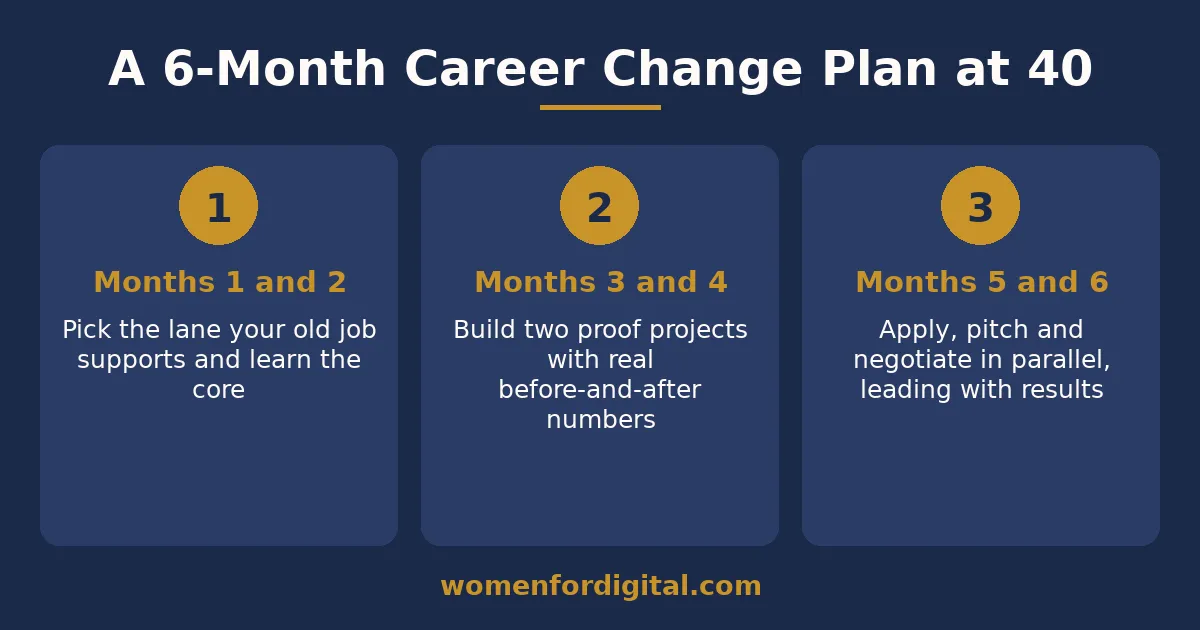
Months 1 and 2: Choose a Lane and Learn the Core
Pick one lane with the decision rule above and write it down. Then take one structured course, such as the Google certificate or free lessons on HubSpot Academy. Set up your LinkedIn profile around your niche, not your old job title. By the end of month two, you should be able to explain your lane in one sentence.
Months 3 and 4: Build Two Proof Projects
Find one real business in your old industry and offer a small, defined project for free or at a low fee. Measure a starting number, such as email open rate or enquiries per week, and report the change. Then repeat with a second business, because two results show a pattern rather than luck.
Months 5 and 6: Apply, Pitch and Negotiate
Apply for roles and pitch freelance clients in parallel, and track both in one sheet. Lead every application with a result, not your history. When an offer comes, negotiate: in the Link in Bio salary survey, nearly 75% of those who negotiated got more than the first offer.
Want a longer view of where this leads? Our digital marketing career path for beginners maps six stages from first role to senior level.
How to Handle Age During a Digital Marketing Career Change at 40 With No Experience
You cannot control bias, but you can control what reviewers see. Four moves make a clear difference.
- Trim your CV to the last 10 to 15 years. Older roles rarely matter to a marketing hiring manager, and they only signal age.
- Lead with a results section. Put your two proof projects at the top, with numbers, above any job history.
- Show current tools by name. List the analytics, ad and AI tools you use weekly, and link to work that proves it.
- Prepare a 30-second answer to “Why the change?” Keep it forward-looking: what you learned, why this field, and what result you can deliver next month.
If someone calls you overqualified, treat it as a question about commitment and pay. Say you chose this role on purpose, name what you want to learn, and confirm you have researched the salary range.
Mistakes That Stall a Digital Marketing Career Change at 40 With No Experience
Most failed switches share the same few errors. Each one has a simple fix.
- Quitting too early. Without a runway, stress pushes you into the first bad offer. Keep income until proof exists.
- Learning everything at once. Five channels at a beginner level impress nobody, while one channel at a working level gets you hired.
- Applying only through job boards. Experienced workers crowd those listings, so use your existing network, which is bigger at 40 than at 25.
- Apologising for your age. Nerves show. Talk about results and judgement instead, because that is what you bring.
The job-board point deserves numbers, because it is where a digital marketing career change at 40 with no experience most often stalls. Indeed Hiring Lab’s analysis found that workers with 10 or more years of experience made up 30% of all entry-level applications. So a warm introduction from your old industry is worth far more than one more cold application.
A Digital Marketing Career Change at 40 With No Experience, Wherever You Live
The client pool is global. DataReportal counts 6.12 billion internet users and 5.79 billion social media user identities worldwide, though identities may not be unique people. The World Bank says small and medium enterprises make up around 90% of businesses and more than half of global employment.
Where you live still changes three things. Pay comes first: the salary figures above are American, so check local job boards before you set expectations. Legal protection comes second, because age rules differ by country and some places have none for hiring.
Currency and logistics come third. Working for clients abroad? Compare the total cost of receiving payment, including fees and exchange margins. Then agree working hours across time zones up front.
What Doing This Right Looks Like
Susanna Kelland spent about 20 years in advertising sales, mostly print media. At 50 she decided to move into digital marketing and documented the switch on her own site. She completed the Google certificate, a Google Analytics course and a three-month boot camp in about seven months, full time.
Her training cost $894, and new equipment pushed the total to about $2,500. She now works as a digital account representative for a company that markets small businesses.
Why did it work? She did not start from zero. Two decades of selling advertising to businesses meant she already understood clients, budgets and objections. She chose a role that paired her old strength with her new skills, which is exactly the niche move described above. This is one person’s account, not a guarantee, but it shows the method.
Frequently Asked Questions About a Digital Marketing Career Change at 40 With No Experience
Is 40 too old to start a digital marketing career?
No. US data puts the median age of marketing managers at 38.9, so 40 is close to average. Employers still want proof, so build two small projects before you apply.
How long does a digital marketing career change at 40 with no experience take?
Plan for six to twelve months while working part time on it. Full-time study can shorten that, as one career changer finished her training in about seven months.
Do I need a degree to switch into digital marketing at 40?
Usually not. Google’s certificate requires no degree, and most employers care more about results you can show. Some large firms still screen for degrees, so target smaller businesses and agencies first.
Will I have to take a pay cut?
Possibly at first. Talent Scout’s US data shows median advertised pay of $62,814 for junior roles and $87,500 for mid-level roles, so pay can recover quickly once you have results.
Should I freelance or look for a job?
Do both for the first few months and follow whichever brings results first. Freelancing suits people with a strong network, while a job suits people who need steady income and mentoring.
Which digital marketing skill is easiest to learn at 40?
Email marketing and local search are good starting points because they reward clear writing and patience. Pick the lane where your previous job already gave you half the skill.
Is a digital marketing career change at 40 with no experience harder for women?
It can be. The Neumark field experiment found stronger evidence of age bias against older women than men. Leading with measured results and using warm referrals reduces how much a CV reviewer can guess.
What should my first project be?
Pick a small task for a real business in your old industry, such as fixing its search listing or writing a three-email welcome sequence. Record a starting number and report the change after four weeks.
How do I avoid age bias in applications?
Trim your CV to the last 10 to 15 years, lead with results, and name the current tools you use. Use warm introductions from your network wherever possible.
Start Your Switch This Month
A digital marketing career change at 40 with no experience is less about age and more about proof. Choose the lane your past career already supports, build two measured projects, and let your results do the talking. Read our guide to a digital marketing career change after 30 for more step-by-step detail, and browse more guides on the Women For Digital blog.
If you are a woman aged 20 to 35, Women For Digital runs a fully funded scholarship that covers the $235 tuition, with a $30 commitment fee for accepted applicants. The four-week programme offers a social media and advertising track or a WordPress and SEO track, each ending in a portfolio piece, with career coaching and job search support. Read how it works and check whether applications are open.
Every figure in this guide was checked against its original source before publication. Figures marked as illustrative are invented examples, not real results.
Ready to take the first step? Visit Women For Digital today.