
The best digital marketing training for stay at home moms is short, self-paced and built around one skill you can sell, such as social media, writing, email or WordPress. Start with a free course, study in 25-minute blocks, and finish one real project within 12 weeks. Pay for training only after that project proves you will finish.
Key Takeaways
- Time is the real constraint. US mothers whose youngest child is under 6 spend about 2.5 hours a day on childcare as a main activity, according to the Bureau of Labor Statistics, so choose training that works in short blocks.
- Price varies more than quality does. Google’s Digital Marketing and E-commerce certificate costs $49 a month in the US and Canada, while one live university course can cost over $1,600.
- A certificate is not the finish line. Google says 75% of its certificate graduates report a positive career outcome, but that figure is self-reported and counts raises and promotions too.
- Demand exists for mom-friendly skills. Talent Scout found 42.2% of US social media manager postings still open after 30 days, which suggests employers struggle to fill the role.
- Scams target parents. The US Federal Trade Commission warns that promises of big income for little work are almost always a scam, so judge training by projects, not promises.
In this guide: the honest answer, the time problem, three training formats, choosing a format, five flexible paths, costs, red flags, mistakes, a 12-week plan, how to measure progress, a real case and FAQs.
The Honest Answer: Most Digital Marketing Training for Stay at Home Moms Assumes Free Evenings
Most guides to digital marketing training for stay at home moms list courses and stop there. The missing piece is fit. A course designed for a student with three free hours every evening will fail a parent who gets twenty quiet minutes at a time.
This guide fills that gap. It explains how training formats differ, which skills survive interrupted study, what each option costs and how to spot the scams aimed at parents. It closes with a 12-week plan and a way to measure whether the plan is working.
A note on the ground rules. Every statistic below comes from a named source, and US-only figures are labelled. Advice about study habits is my reading of how people learn under interruption, not a settled fact, so test it against your own week.
Your Real Constraint Is Fragmented Time, Not Talent
The American Time Use Survey from the US Bureau of Labor Statistics shows the scale of the problem. Mothers whose youngest child is under 6 spend 2.53 hours a day caring for children as a main activity. Fathers in the same situation spend 1.66 hours.
That figure understates the load, because it only counts care as the main activity. It misses the hours you cook, clean or study while a child needs you. So your study time will not arrive in neat blocks. It will arrive in fragments.
The pattern is global. The International Labour Organization estimates that 708 million women are outside the labour force because of unpaid care, compared with 40 million men. Any digital marketing training for stay at home moms has to respect that reality or it will not get finished.
Which Parts of Training Survive Interruptions
Not every task needs deep focus. Watching a ten-minute lesson, writing captions or reading a case study all work in short blocks. Setting up an ad account, building a website page or analysing a report does not, because losing your place costs you the whole session.
Here is the decision rule. Use weekday fragments for lessons and practice drafts. Save one protected 90-minute block a week, such as a weekend morning, for setup and analysis work. If you cannot find that block yet, choose a path that needs less of it.
How Digital Marketing Training for Stay at Home Moms Works: Three Formats
Training comes in three shapes. Each one trades flexibility against structure, and the right choice depends on your hours and your budget.
Self-Paced Online Courses
You watch lessons and complete tasks whenever you like. Google’s Digital Marketing and E-commerce certificate on Coursera is the best-known example. It has eight courses and more than 190 hours of instruction and practice, and it needs no degree or experience.
Google suggests six months at ten hours a week. Free options such as HubSpot Academy, Google Skillshop and Meta Blueprint cost nothing. The trap is completion, because nobody notices when you stop.
Live Cohort Courses
You join a class that meets at set times, usually online. The University of Washington’s continuing education arm, for example, runs its Applied Digital Marketing capstone as a 10-week course on Monday evenings over Zoom. Students design a marketing plan for a real client.
Cohorts raise completion because classmates and deadlines keep you moving. However, fixed times clash with bedtime routines, and the price is higher. That single capstone course lists a cost of $1,615.
Short Intensive Programmes
Intensives compress one skill into a few weeks, often with coaching and a portfolio project. They suit you if you can protect a short period, such as school term time, and they fail if your childcare is unreliable. Ask what you will have built by the last day, not only what you will have watched.
Match Digital Marketing Training for Stay at Home Moms to Your Week
Use this rule to pick a format in two minutes. Answer the first question that fits your life, then start there.
- Under five hours a week, all in fragments? Choose free self-paced lessons and a writing or social media path, because both grow in small pieces.
- One reliable evening a week? A live cohort course can work, since the fixed time becomes your protected block.
- A few weeks of steady childcare ahead? An intensive fits, because it turns that window into a finished portfolio piece.
- No budget at all? Stay with free training and put your effort into one real project for a local business.
Whatever you choose, digital marketing training for stay at home moms works best when the format matches the week you actually have, not the week you hope for.
5 Flexible Paths and the Digital Marketing Training for Stay at Home Moms Each Needs
Pick your path with two filters. Can you practise it in short blocks? And can you show a small business a result within a month? These five paths pass both tests.
1. Social Media Manager
You plan, write and schedule posts for a business and report what worked. Talent Scout’s Marketing Hiring Gap Report found 42.2% of US social media manager postings still open after 30 days. Its CEO says tight budgets explain much of that gap, so expect modest starting pay.
Training to take: Meta Blueprint’s free lessons plus a Canva tutorial. The trap: being “always on”. The Link in Bio survey of 2,500 social media professionals found 77% reported active or recent burnout, so set reply hours in writing.
2. Content Writer
You write blog posts, product pages and newsletters. Writing is the most fragment-friendly skill on this list, because a draft can grow ten minutes at a time. HubSpot’s State of Marketing survey found 42.5% of marketers use AI extensively for content creation, which makes generic copy cheap.
Training to take: HubSpot Academy’s free content marketing course. The trap: selling words instead of expertise. So write about a topic you know from life, such as parenting, food or health.
3. Email Marketing Assistant
You write campaigns, build welcome sequences and keep contact lists clean. Emails are planned and queued in advance, which suits a parent’s unpredictable day. Most email tools offer free plans, so you can practise without paying.
Training to take: the email module inside Google’s certificate or a free course from your chosen email tool. The trap: ignoring deliverability, since a beautiful email that lands in spam earns nothing.
4. WordPress and SEO Site Builder
You build and improve small business websites so customers can find them. W3Techs reports that WordPress runs 40.2% of all websites, which means a huge pool of sites to build and fix.
Training to take: a structured WordPress course plus Google’s free Search Console lessons. The trap: this path needs your protected 90-minute block, because site setup punishes interruptions.
5. Marketing Virtual Assistant
You schedule posts, tidy inboxes, research competitors and prepare simple reports. HubSpot found that workload rose significantly for 25.7% of marketers and moderately for 47.4%. Stretched teams need reliable part-time help, and this role rewards organisation more than a specialism.
Training to take: any free foundations course plus one scheduling tool. The trap: staying generic. Pick a specialism within six months, or your rate will stall.
What Digital Marketing Training for Stay at Home Moms Really Costs
The cost range runs from zero to several thousand dollars. Price tells you little about quality, so compare what you get for each dollar.
- Free: HubSpot Academy, Google Skillshop and Meta Blueprint. Excellent for foundations, but nobody checks your work.
- Low cost: Google’s certificate costs $49 a month in the US and Canada after a 7-day trial. At the suggested six-month pace, my arithmetic puts the total at about $294, and Coursera lists financial aid.
- Mid to high cost: university and cohort courses. The Washington capstone alone costs $1,615, and a full certificate needs more than one course.
Use one rule before you pay anything. Finish a free module first. If you cannot complete a free two-hour course in two weeks, a paid six-month course will not fix the schedule problem. Fix the schedule, then spend. That order protects both your budget and your confidence, which is the point of good digital marketing training for stay at home moms.
A finished project also matters more than the badge. Google says 75% of its certificate graduates report a positive career outcome within six months, but the figure comes from a US graduate survey. It is self-reported, and it includes raises and promotions, not only new jobs.
Red Flags: Spotting Digital Marketing Training for Stay at Home Moms That Is Really a Scam
Parents who want flexible income are a favourite target. The Federal Trade Commission’s guide to job scams warns against paying for “starter kits, so-called training, or certifications that are useless”. It also says an offer of a lot of money for little work in a short time is almost certainly a scam.
The FTC’s page on business offer and coaching scams lists typical claims, such as guaranteed income and a “proven system”. It advises you to research complaints, treat testimonials with scepticism and talk to someone you trust before paying.
Walk away from any course that shows these signs:
- Income screenshots instead of a syllabus. Real training shows you the lessons and the projects first.
- Countdown timers and “last seats” pressure. Good programmes run again, so urgency is a sales tactic.
- Resell rights or recruitment bonuses. If you earn by selling the course itself, you are buying a sales job.
- No named teachers or graduates. You should be able to check who teaches and where graduates work.
A 12-Week Digital Marketing Training for Stay at Home Moms Plan
This plan assumes about seven hours a week: five weekday fragments plus one protected 90-minute block. Change the pace to suit your family, but keep the order. This sequence turns digital marketing training for stay at home moms into proof you can show a client.
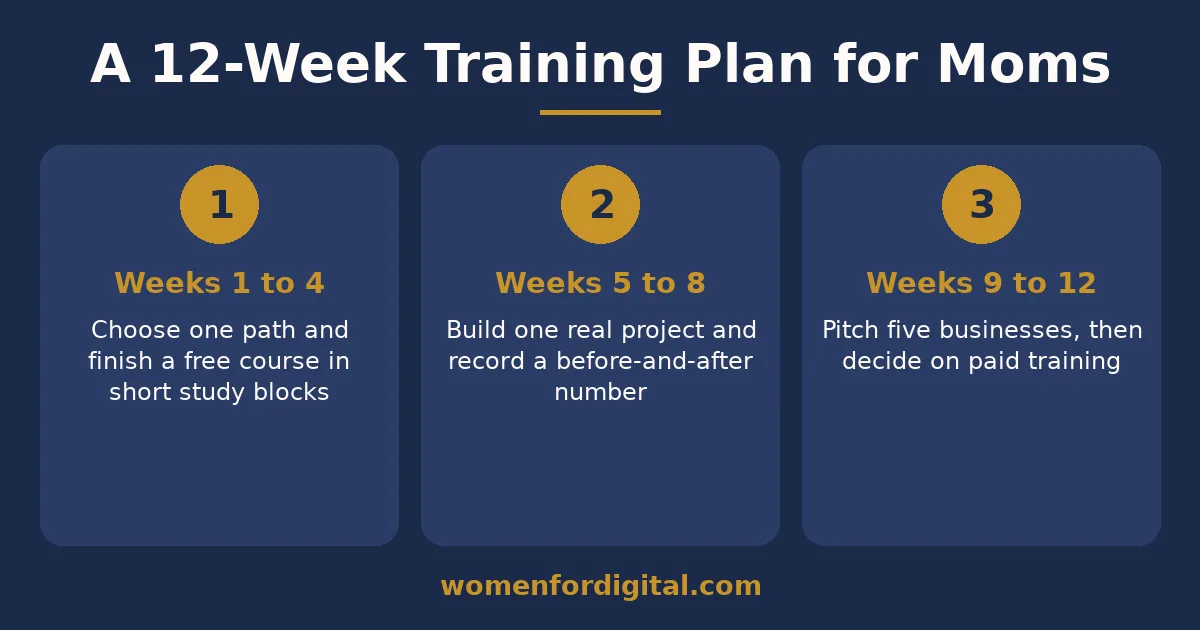
Weeks 1 to 4: Choose One Path and Finish a Free Course
Choose one of the five paths. Then complete one free foundations course, logging each session in a simple note. By week four you should know whether this skill holds your interest when you are tired, which is the honest test.
Weeks 5 to 8: Build One Real Project
Offer a small, time-limited project to a friend’s business, a school group or a local charity. Record a starting number, such as weekly reach or email sign-ups. Our list of portfolio ideas for beginners has eleven projects that need no clients at all.
Here is an illustrative example, with invented numbers. A mother of two writes a four-email welcome series for a friend’s candle shop during nap times. After four weeks, the shop’s sign-up list grows from 60 to 140 and three new orders mention the emails.
Weeks 9 to 12: Package, Pitch and Decide on Paid Training
Write your offer in one sentence, turn the project into a one-page case study and pitch five local businesses. Only now decide whether paid training makes sense, because you know your real pace and your real interest.
Mistakes That Waste Digital Marketing Training for Stay at Home Moms
Most parents who stall do so for fixable reasons. These four come up again and again.
- Starting three courses at once. Each one gets a fraction of your scarce time, so none reaches the project stage.
- Studying only when the house is quiet. Quiet rarely comes. Use fragments for lessons and save your protected block for setup work.
- Collecting certificates instead of results. A client cannot see your study hours, but they can see a campaign you ran.
- Buying the expensive course first. Paying does not create time. Prove your pace on free training, then upgrade.
How to Measure Whether Your Training Is Working
Motivation fades, so track numbers instead. Four simple measures tell you whether your digital marketing training for stay at home moms is turning into a skill.
- Study sessions per week: the count of blocks you actually completed. Aim for consistency, not length.
- Practice outputs: drafts, posts or pages you made. Lessons watched do not count here.
- Project result: the before-and-after number from your real project.
- Pitches and replies: messages sent and answers received, the first sign that someone will pay.
Read them together. Plenty of sessions but no outputs means you are watching, not practising. Outputs without pitches means fear is holding you back. That second pattern is the most common stall, so set a pitch target from week nine.
Here is an illustrative example, with invented numbers. In week six, one parent logs nine study sessions but only one practice draft. She changes the rule: every session must end with something made, even a single caption. By week eight she has twelve drafts and her first project underway.
Where You Live Changes Price, Pay and Childcare Maths
The skills are global, and so is the market. DataReportal counts 6.12 billion internet users and 5.79 billion social media user identities, which may not all be unique people. The World Bank says small and medium enterprises make up around 90% of businesses, and they are your likeliest first clients.
Still, location changes how digital marketing training for stay at home moms pays off in three ways. First, course prices are often quoted in US dollars, so check local pricing and financial aid. Second, pay differs, and the US figures in this guide are ceilings for comparison. Third, childcare costs decide how many paid hours make work worthwhile, so do that sum before you commit to a paid course.
What Doing This Right Looks Like
Corine Rigby was a stay-at-home mom in a single-income household who started a food blog and wanted the marketing skills behind it. According to the University of Washington’s profile, she could not afford the certificate until a scholarship covered it.
The course ended with a capstone project, a marketing plan for a real start-up. After finishing, she applied for digital marketing roles and landed an interview within a day. The next day, a Seattle firm called AssetLab offered her the job.
Why did it work? She had a live project to talk about, a portfolio to show and a clear goal before she enrolled. My reading is that the scholarship removed the money barrier, but the capstone removed the trust barrier.
A cautionary case matters too. Digital Mums, a UK company built to train mothers in social media through six- and 12-month remote courses with real projects, later went into liquidation. So choose training where the skills and the portfolio stay useful even if the provider disappears.
Frequently Asked Questions About Digital Marketing Training for Stay at Home Moms
What is the best digital marketing training for stay at home moms?
The best option is a self-paced course in one skill that ends with a real project. Start free with HubSpot Academy or Meta Blueprint, then consider Google’s certificate once you know you will finish.
How many hours a week do I need?
Plan for about seven hours a week, split into short weekday sessions and one longer block. Google suggests ten hours a week for its certificate, which takes about six months at that pace.
Can I learn digital marketing for free?
Yes. HubSpot Academy, Google Skillshop and Meta Blueprint all offer free lessons. The free route lacks feedback, so pair it with a real project for a local business.
Is digital marketing training for stay at home moms worth paying for?
It can be, once you have finished a free course and know your real pace. Paid training is worth it when it adds feedback, a portfolio project or career support.
Which digital marketing skill is easiest to learn around children?
Content writing and social media are the easiest to practise in short blocks. WordPress and paid ads need longer, uninterrupted sessions for setup work.
How do I avoid training scams?
Avoid any course that promises big income for little work, pressures you with countdowns or pays you to recruit others. The FTC advises checking complaints and talking to someone you trust before paying.
Do I need a degree to get work after training?
No. Freelance clients and small businesses judge you on results, so a finished project matters more than a diploma for most of these paths.
Choose One Path and Start This Week
Good digital marketing training for stay at home moms fits your real week, teaches one sellable skill and ends with proof. Pick a path today, finish a free course this month, and build your first project before you spend money.
If you want more context first, read our guide to the best digital marketing jobs for women returning to work, ask whether digital marketing is a good career for beginners, or browse the Women For Digital blog.
If you are a woman aged 20 to 35, Women For Digital runs a fully funded scholarship that covers the $235 tuition, with a $30 commitment fee for accepted applicants. The four-week programme offers a social media and advertising track or a WordPress and SEO track. Each ends in a portfolio piece, with career coaching and job search support.
The programme reports that 86% of graduates are employed within six months, its own figure rather than an independent audit. Read how it works and check whether applications are open.
Every figure in this guide was checked against its original source before publication. Figures marked as illustrative are invented examples, not real results.
Ready to take the first step? Visit Women For Digital today.