
A digital marketing career change after 30 is not the risky move it feels like. Employers extend the most callbacks to candidates in their early thirties, not the fewest. Your existing work skills usually transfer faster than you expect. This guide gives you six concrete steps, real hiring data and a realistic timeline, so you can move with a plan instead of a worry.
Key Takeaways
- Age discrimination research targets workers in their fifties and sixties, not their thirties. A Federal Reserve Bank of San Francisco study of more than 40,000 fictitious job applications found the youngest group, aged 29 to 31, received the highest callback rates of any age tested.
- Employers are hiring more seniority, not less. Indeed Hiring Lab found senior-level job postings rose 14.7% year over year while entry-level postings fell 6.3%, a shift that favors someone with a decade of work experience behind them.
- Skill overlap predicts success more than age does. The American Institute for Economic Research found people who changed careers after 45 and succeeded averaged 50% overlap between their old skills and their new role, against just 14% for those who struggled.
- Most employers still say a degree is typical, not required, for digital roles. The US Bureau of Labor Statistics lists education for web and digital roles as ranging from a high school diploma to a bachelor’s degree, depending on the employer.
- Global demand for these skills is large enough to absorb a career changer. The World Bank counts small and medium enterprises at around 90% of all businesses worldwide, and most are online, competing for exactly the skills a career changer can learn in months.
The Honest Answer: A Digital Marketing Career Change After 30 Beats the Odds You Fear
Most people worry a digital marketing career change after 30 means competing against 22-year-olds while carrying an age penalty. The data says the opposite.
The Federal Reserve Bank of San Francisco’s landmark hiring study sent identical fictitious resumes to more than 13,000 positions. Researchers split the applications into three age groups: young, middle-aged and older. The youngest group, aged 29 to 31, consistently received the highest callback rates. Callbacks fell sharply for applicants in their sixties, not their thirties.
Separately, a Transamerica Institute survey of nearly 1,900 employers found something just as telling. The median age employers consider “too old” to hire is 58. The median age considered too old to work at all is 62. Thirty sits nowhere near either number.
So the real barrier to a digital marketing career change after 30 is not your birth year. It is whether you can prove a new skill fast enough to compete with people already doing this work. That is what the six steps below solve.
There is a real reason marketing looks harder to break into than it should. The Bureau of Labor Statistics projects advertising, promotions and marketing manager roles to grow 6% over the next decade, faster than average, with median pay of $165,780.
That growth attracts competition from every direction, career changers included. The advantage goes to whoever shows up with proof, not the person who waits the longest to feel ready. Waiting is the one strategy the data above does not reward.
Why Your Existing Career Is an Asset, Not a Setback
A digital marketing career change after 30 usually means you already have skills that took someone else years to build. Communication, project management, client handling and basic data literacy all transfer directly into marketing roles.
The American Institute for Economic Research surveyed people who changed careers after 45. It found 82% reported a successful transition. Among the successful group, average skill overlap between the old career and the new one reached 50%. Among those who struggled, it was only 14%. That single number is the whole strategy for a digital marketing career change after 30: find your 50%, then build the other half fast.
Map What You Already Have
Before you touch a course or a certificate, list ten things your current job requires you to do well. A sales role hands you persuasion and objection handling, which map onto ad copy and email sequences. A teaching role hands you the skill of explaining complex ideas simply, which maps onto content and SEO writing. An operations role hands you process and reporting, which maps onto campaign tracking and analytics.
Customer service builds patience and de-escalation skills, both useful when you manage a brand’s comments and reviews. Bookkeeping and admin work build a habit of checking numbers before you trust them, exactly what campaign reporting demands.
Even parenting or community volunteering builds scheduling and coordination skills that translate into running a content calendar. None of these feel like marketing skills until you write them down next to a marketing task and see the match.
Six Steps That Actually Work
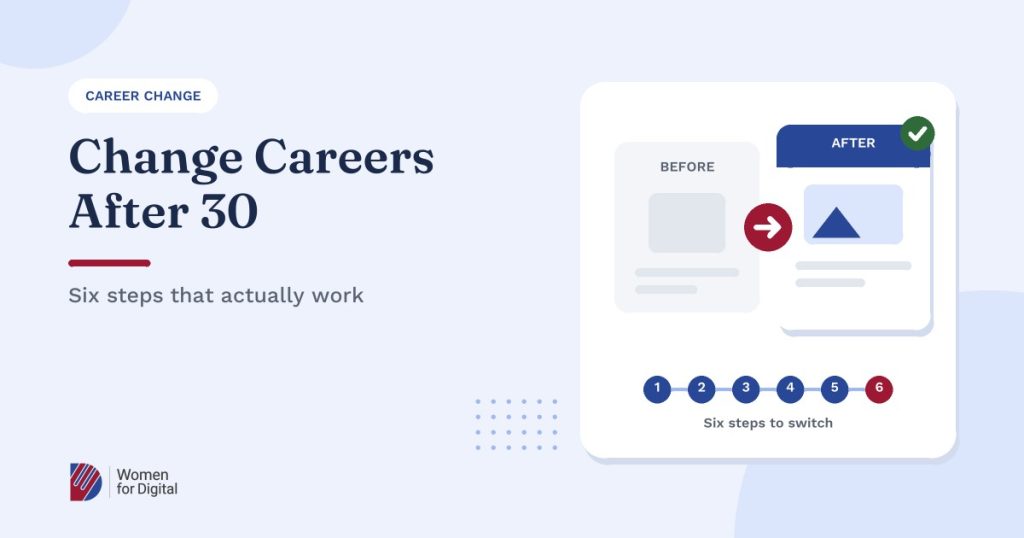
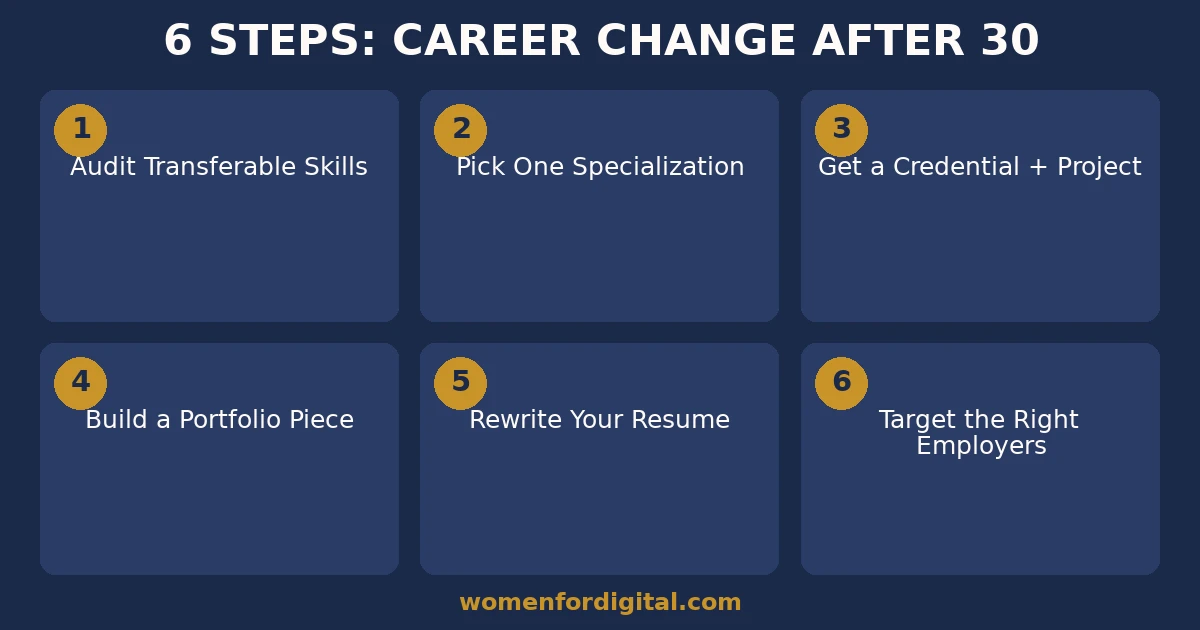
These six steps follow the order that actually works for a digital marketing career change after 30. They are based on the skill-overlap research above and on how hiring managers actually screen candidates.
Step 1: Audit Your Transferable Skills Honestly
Write down your last five years of work in plain language, not job-title language. Note every skill that involves persuasion, writing, numbers, project coordination or customer contact. This list becomes your pitch later, so be specific rather than generic.
Trap to avoid: undervaluing “soft” skills. Cross-team communication ranks among the most valuable skills in HubSpot’s State of Marketing survey of more than 1,500 marketers, alongside automation, AI prompting and data analysis.
Step 2: Pick One Specialization Based on Overlap, Not Interest Alone
Match your audit against the specializations with the highest overlap. A background in customer service or sales points toward paid social or email marketing. Writing, teaching or research experience points toward SEO or content instead. Operations or admin work points toward WordPress and technical SEO, because both reward process and attention to detail.
Trap to avoid: picking the specialization that sounds most exciting. Pick the one where your existing skills already cover half the job.
If operations or admin work is your background, WordPress and technical SEO deserve a closer look. W3Techs reports that WordPress runs 40.2% of all websites and 58.8% of sites with a known content management system, which means the pool of sites that need building, fixing and maintaining is enormous and constantly renewing.
Step 3: Get One Fast Credential and One Real Project
Google’s Digital Marketing and E-commerce certificate needs no prior experience. It is paced at six months and ten hours a week, and covers tools such as Google Ads, Google Analytics and Search Console. Google reports that 75% of graduates see a positive career outcome within six months. That figure is self-reported and US-only, so treat it as encouraging rather than guaranteed.
Treat the certificate as proof you can finish something, not as the credential that gets you hired. The project you build alongside it is what gets you hired. HubSpot Academy offers free courses that pair well with a Google certificate if your chosen specialization leans toward content, email or inbound marketing.
Trap to avoid: collecting certificates for a year without finishing one real project with a measurable result attached.
Step 4: Build One Portfolio Project While You Are Still Employed
Keep your income while you build proof. Offer a friend, a former colleague’s business or a local organization one small project. A content calendar, an ad campaign or a five-page website rebuild all work. Track a before-and-after number, even a modest one.
Write the project up as a short case study once it is finished. State the starting point, the action you took, and the result in a number. Add one sentence on what you would improve next time, since that shows judgment, not just effort.
Trap to avoid: quitting your current job before you have a single portfolio piece. A digital marketing career change after 30 works best as an overlap, not a leap.
Step 5: Rewrite Your Resume Around the New Skill, Not the Old Title
Lead with what you can do in marketing, not with your unrelated job title from a decade ago. Rename your experience section around outcomes. A line naming the result you delivered reads better to a marketing hiring manager than a plain job title like “account manager” ever will. Keep the years of experience, but reframe what they proved.
Trap to avoid: a resume that reads as ten years in one field with one recent unrelated certificate bolted on. Restructure it so the marketing skills lead.
Step 6: Target the Employers Where Skills-Based Hiring Actually Happens
Large corporate employers screen hardest on formal criteria. Harvard Business School and the Burning Glass Institute tracked 11,300 roles at large US firms. Only 3.6% dropped a degree requirement, and the change reached fewer than 1 in 700 new hires in the year studied. Small businesses, agencies and start-ups screen on proof instead, so aim your first applications and pitches there.
Indeed Hiring Lab’s finding that senior-level postings are outpacing entry-level ones works in your favor too. Picture a hiring manager comparing a 22-year-old with no work history against a career changer with a decade of professional habits, even in an unrelated field. Many lean toward the person who has already proven they can hold a job and meet a deadline.
Trap to avoid: applying only to large, recognizable companies first. Save those for your second role, once you have a portfolio and a title to show.
A Realistic Timeline for a Digital Marketing Career Change After 30
Training providers such as SkillUp put the full transition to a digital marketing career at six to twelve months of consistent effort. A career changer with strong transferable skills often lands at the faster end of that range.
Treat the timeline below as a sequence, not a race. Each stage builds the proof the next stage needs, so skipping ahead usually costs more time than it saves. A career changer who rushes straight to applications without a finished project typically spends longer job hunting than one who took an extra month to build proof first.
Months 1 to 3: Skill Audit, Specialization and Certificate
Complete Steps 1 through 3. Study during evenings or weekends while your current income continues. Finish the certificate, but treat it as a stepping stone rather than the finish line.
Months 3 to 5: Build the Portfolio Project and Rewrite Your Materials
Complete Steps 4 and 5. Deliver the project and gather one testimonial with a number in it. Rebuild your resume and LinkedIn profile around your new specialization while the result is fresh.
Months 5 to 8: Pitch and Apply in Parallel
Complete Step 6. Apply to junior roles at small businesses and agencies while you also pitch a handful of freelance clients. Talent Scout’s Marketing Hiring Gap Report puts the median advertised salary for junior marketing roles at $62,814, a useful anchor for your first offer conversation.
A Two-Question Check Before You Commit
If you are still unsure whether a digital marketing career change after 30 is right for you this year, ask two questions instead of guessing.
First, can you name one specialization where your current skills already cover roughly half the job? If yes, you have a fast path, per the overlap research above. If every specialization feels equally foreign, spend one more week on the audit in Step 1 before moving on.
Second, can you protect three to five hours a week for the next three months without sacrificing your current income? If yes, start this week. If not, fix that constraint first, because a digital marketing career change after 30 stalls fastest when the weekly hours never materialize.
Mistakes That Slow a Digital Marketing Career Change After 30
These five mistakes account for most of the stalled attempts at a digital marketing career change after 30. Each one is avoidable once you can name it.
- Waiting for total confidence before applying. A finished portfolio project with a modest result beats a perfect skillset that never gets tested in the real market.
- Hiding your previous career instead of translating it. A decade in another field becomes an asset once you frame it around transferable skills, not a gap you have to explain away.
- Learning everything instead of one specialization. Spreading yourself across five skills at once delays the one finished project that actually gets you hired.
- Quitting your income too early. Build proof on the side first, then make the leap once a role or a repeat client is in hand.
- Applying only to large corporate employers. They screen hardest on formal criteria, exactly where the Burning Glass Institute data shows the least change.
Where You Live Changes the Digital Marketing Career Change After 30 Math
Most of the hiring data in this guide comes from the United States, where the largest detailed studies exist. Your own market will differ in three ways worth checking before you commit.
Local salary bands for junior and mid-level marketing roles vary by country and currency, so treat the US figures here as a reference point, not a target. Remote work also widens your options well beyond your local job market. DataReportal counts 6.12 billion internet users worldwide, 73.8% of the global population, so most of the businesses that could hire you are already online.
Currency and Client Location for Freelance Work
If your digital marketing career change after 30 leans toward freelancing rather than employment, you will likely get paid in a currency other than your own at some point. Compare the total cost of any payment provider, including its exchange margin, before you agree a rate with an international client.
World Bank data on small and medium enterprises shows they account for more than half of global employment. Many of those businesses are exactly the size that hires a career changer directly, rather than through a formal corporate process.
What Doing This Right Looks Like
Graduates of Women For Digital show a structured switch working. According to the programme’s own figures, 29% of graduates are employed before they finish the course, 86% within six months and 98% within eighteen months. Those numbers come from the programme itself rather than an independent audit, so weigh them as a self-reported outcome, not a guarantee.
One graduate, Remilekun, began freelancing before she completed her training. She then moved into a full-time remote role about six weeks after finishing. Rather than wait for a perfect skillset, she built proof first and let the proof do the persuading, which matches the overlap logic behind Steps 3 and 4 above.
Nothing about her path required starting over from zero. It required translating what she already knew into a new specialization, then proving it quickly. That is the same order this guide has walked you through, applied to a real transition rather than a hypothetical one.
The lesson generalizes beyond one graduate’s story. A digital marketing career change after 30 rewards people who treat their existing experience as raw material rather than as baggage to hide. The audit in Step 1 exists precisely to surface that material before you spend months learning skills you may already half own.
Frequently Asked Questions About Digital Marketing Career Change After 30
Is 30 too old to start a career in digital marketing?
No. Hiring research shows employers give the most callbacks to candidates in their late twenties and early thirties, not the fewest. Age discrimination research focuses on workers in their fifties and sixties instead.
How long does a digital marketing career change after 30 usually take?
Most people need six to twelve months of consistent part-time effort, following training providers’ general estimates for the field. Strong transferable-skill overlap can shorten that range.
Do I need a degree to change careers into digital marketing?
Not always. The US Bureau of Labor Statistics lists education for web and digital roles as ranging from a high school diploma to a bachelor’s degree. Small businesses and agencies in particular hire on proof of skill.
Should I quit my job before starting a digital marketing career change after 30?
No, not at first. Build your certificate and portfolio project alongside your current income. Apply or pitch clients only once you have proof, before you give up your salary.
Which digital marketing specialization suits a career changer best?
The one with the most overlap with your current skills. Sales and customer service backgrounds often suit paid social or email. Writing and teaching backgrounds often suit SEO or content.
Will my previous, unrelated experience count against me?
Only if you present it as unrelated. Reframed around transferable skills like communication, project management and data handling, a decade of experience becomes an advantage over a 22-year-old with none of it.
Can a digital marketing career change after 30 lead to freelancing instead of a job?
Yes. Many career changers freelance first to build a portfolio. Some continue independently, while others convert that proof into a full-time role once they have client results to show.
What is the biggest mistake career changers make in their thirties?
Treating their previous career as a liability to hide rather than a set of skills to translate. A hiring manager responds better to a clear map from old skill to new task than to a resume that pretends the old career never happened.
Start the Change This Month
A digital marketing career change after 30 is a skills problem, not an age problem. Audit your transferable skills this week. Choose one specialization, then finish one proof project before you send a single application. The data in this guide says the market is on your side. Your next move is to prove it in your own portfolio.
If you want a fully funded way to build that proof, Women For Digital runs a scholarship for women aged 20 to 35. It covers the $235 tuition for accepted applicants, who pay a $30 commitment fee, across a four-week programme with two tracks: social media and advertising, or WordPress and SEO.
Every track ends with a portfolio piece plus career coaching and job search support, so you leave with proof ready for your first application. See the five-step process and check whether applications are open.
Want to compare paths first? Read our guide to digital marketing internship vs freelancing for beginners, or see the digital marketing career path for beginners for what comes after your first role. More guides live on the Women For Digital blog.
Every figure in this guide was checked against its original source before publication. Figures marked as illustrative are invented examples, not real results.
Ready to start? Visit Women For Digital today.