
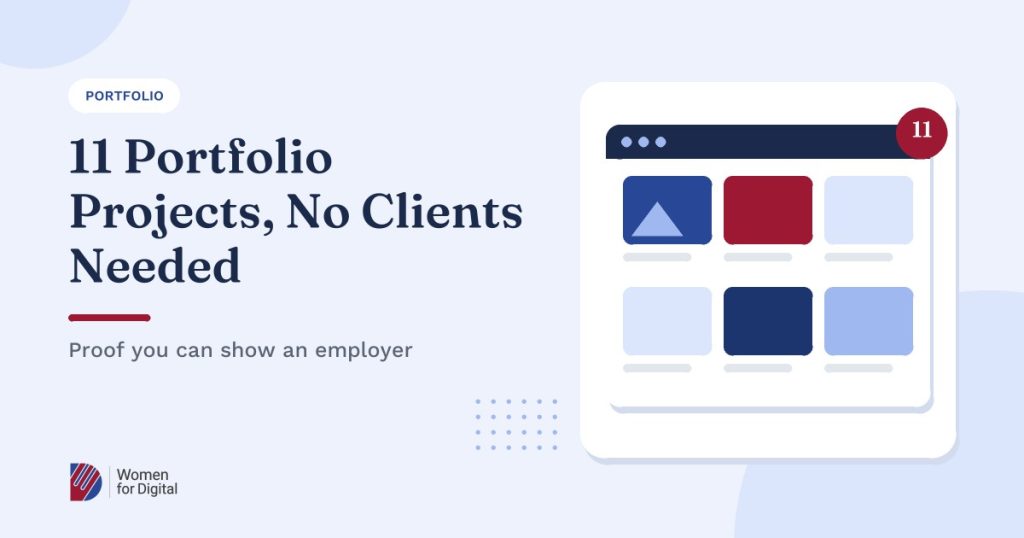
The best digital marketing portfolio ideas for beginners with no experience are self-run projects that end in a number: a niche social account, a small ad test, a blog or an email sequence. Pick three, finish each as a short case study, and label any mock work honestly. Proof of one real decision beats ten pretty screenshots.
Key Takeaways
- Employers like portfolios, but few ask for them. Canva’s survey found that 72% of hiring managers prefer candidates with a portfolio, while TestGorilla found that only 16% of employers use assignments or work samples. So your portfolio must make checking your skills easy.
- Degrees still filter. A Harvard Business School and Burning Glass Institute study found that only 3.6% of roles at large US firms dropped a degree requirement, so digital marketing portfolio ideas for beginners with no experience matter most when you have no diploma to lean on.
- Three strong pieces beat ten weak ones. Guides from LSBUK and Digital Toppers both suggest a small set, three to five and four to six pieces respectively, so depth wins over volume.
- Free tools cover almost everything. Google’s demo account, HubSpot Academy, a free WordPress site and free email plans let you build every project below without paying for software.
- Honest labels protect you. Mark spec work as spec, ask permission before using a real business, and never invent a result.
Digital Marketing Portfolio Ideas for Beginners With No Experience Must Show a Number and a Decision
Most portfolio advice tells you to “show your work”. That is half the answer. A hiring manager or a small-business owner wants to see how you think, and thinking shows up as decisions: what you tested, why you chose it and what changed.
So a good project has two parts. The first is a number, such as a click rate, a follower count or a cost per lead. The second is a decision, such as “I changed the opening line because the first version got fewer replies”. Together they prove that you can learn from results, which is the core of the job.
This guide gives you 11 digital marketing portfolio ideas for beginners with no experience. Each one lists the tools, the time it takes, the number to record and the trap to avoid. Every idea can run with no client and no budget, although a few get better with a small test spend.
What the Hiring Evidence Says About Portfolios
Hiring Managers Say They Want Proof, but Few Test It
Canva’s job-search survey, run by Sago across 10 countries with more than 10,000 respondents, found that 72% of hiring managers prefer candidates with a portfolio. Canva sells design tools, so read that with care, and note that the survey counts websites, presentations and social pages as portfolios.
TestGorilla’s State of Skills-Based Hiring report paints a quieter picture. It surveyed 1,084 hiring decision-makers and 1,076 job seekers in the UK and US. Of those employers, 85% said they use skills-based hiring and 76% said they use skills tests, but only 16% said they use assignments or work samples. TestGorilla commissioned the research and sells skills tests, and the answers are self-reported.
My reading is that both numbers can be true at once. Managers like the idea of proof, but most have no process to collect it. A portfolio that arrives with your application does the checking for them. That is why digital marketing portfolio ideas for beginners with no experience can matter more than another certificate.
The Degree Filter Explains Why This Matters
Harvard Business School and the Burning Glass Institute studied 11,300 roles at large US firms in their skills-based hiring research. Only 3.6% of those roles dropped a degree requirement, and 45% of the companies announced changes without changing their practice.
Competition adds pressure. Indeed Hiring Lab found that 49% of applications from workers with 10 or more years of experience went to entry-level roles. You compete with veterans as well as other beginners, so a vague “I love social media” will not win. A finished case study with a number will.
What Every Portfolio Piece Needs Before You Publish It
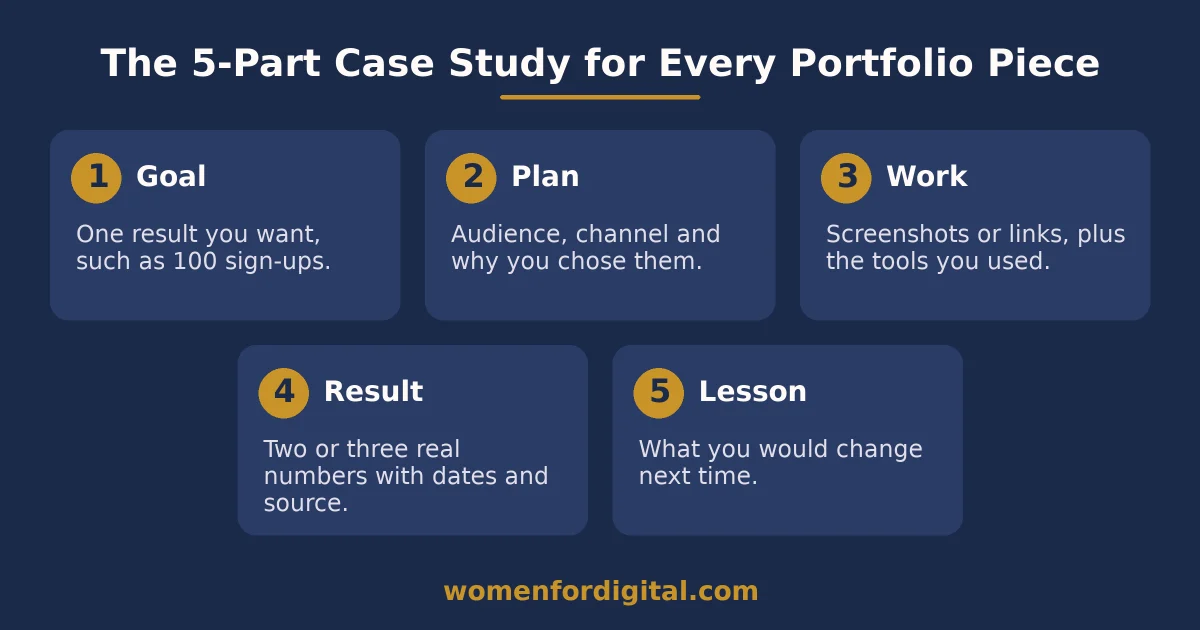
Every one of the digital marketing portfolio ideas for beginners with no experience below should end as a one-page case study. Use five parts, and keep each to two or three sentences.
- Goal: the one result you wanted, such as 100 email sign-ups.
- Plan: the audience, the channel and why you chose them.
- Work: screenshots or links to what you made, plus the tools you used.
- Result: two or three real numbers, with the date range and the tool that reported them.
- Lesson: what you would change next time.
BrainStation’s guide to marketing portfolios recommends a similar brief, creative, tools and result layout. Its advice to explain your own role matters most when a project involved other people.
Label Mock Work, Get Permission and Never Invent Results
Three rules keep your portfolio honest. First, if you make a campaign for a brand that did not hire you, write “spec project, not commissioned” at the top. Smarketers Hub gives the same advice for mock projects.
Second, if you work with a real business, ask for written permission to show the results. Third, if a test fails, show it anyway, along with what you learned. A candid failure looks more credible than a suspiciously perfect chart.
11 Digital Marketing Portfolio Ideas for Beginners With No Experience
Most of these digital marketing portfolio ideas for beginners with no experience cost nothing. Read all 11, then choose three that fit the role you want.
1. Run a 30-Day Niche Social Account
Pick one topic you know, such as budget travel, local food or study tips, and post on one platform for 30 days. HubSpot’s State of Marketing survey of more than 1,500 marketers ranks short-form video as the best content format, at 48.6%. So test at least five short videos.
Time: 30 minutes a day. Record: views, follows and saves per post, plus the three best and three worst posts. Trap: posting without a hypothesis. Write one sentence before each post about what you expect to happen.
2. Build a Four-Week Content Calendar for a Real Small Business
Ask a shop, café or trainer you know for permission to plan their social content. Write 12 posts, design them in a free tool and hand over the calendar. Offer to publish them if the owner agrees.
Time: six to eight hours. Record: reach and replies per post if published, or the owner’s written feedback if not. Trap: a calendar with no goal. Start with a target such as ten enquiries a month.
3. Write Five SEO Posts on a Free Blog
Choose a narrow topic, find questions people ask about it and write five useful posts of 1,000 words or more. Markampus suggests eight to 12 posts for a full blog project. Five is enough for a beginner piece.
WordPress powers 40.2% of all websites, according to W3Techs, so using it also builds a skill employers see daily. Record: impressions and clicks in Google Search Console. Trap: expecting fast traffic. New sites take time, so report impressions and the pages you improved.
4. Run a Small Paid Ad Test
Promote a real offer, such as a free guide you wrote, with a tight budget cap. LSBUK suggests £50 to £100 for a small paid campaign, while Markampus suggests $5 to $10 a day for two to four weeks. Set a cap you can afford to lose, and test two versions of the headline.
Record: spend, clicks, cost per click and cost per result for each version. Trap: spending without tracking. Set up conversion tracking first, or you will have nothing to report.
5. Build a Five-Email Welcome Sequence
Create a simple lead magnet, such as a checklist, then write five emails: delivery, best tip, a story, a case example and a call to action. Markampus outlines a similar sequence. Free plans from email tools let you send it to a small list. Check each tool’s current limits before you start.
Record: open rate, click rate and unsubscribes per email. Trap: a list of one. Invite 30 to 50 real people who chose to hear from you, and never add anyone without consent.
6. Audit a Local Business’s Google Business Profile
Find a nearby business with a thin profile. Check its hours, photos, categories, description and reviews, then write a one-page audit with ten fixes. Google says Business Profile is free, but only for businesses that meet customers face to face. It is not for online-only businesses.
Record: a before-and-after checklist and, with permission, profile views after the owner applies your fixes. Trap: editing someone’s profile without access. Send recommendations, and let the owner make the changes.
7. Analyse the Google Analytics Demo Account
Google’s demo account is free and contains real data from the Google Merchandise Store and a mobile game called Flood-It!. You get viewer access, so you can filter and build reports, but you cannot export data or change settings.
Ask one business question, such as “which channel brings the most purchases?” Then write a one-page insight report with a chart and two recommendations. Trap: presenting it as your own results. It is an analysis exercise, so label it that way.
8. Write a Public Brand Teardown
Choose a brand with a public presence and review its emails, ads or social posts. List three strengths, three gaps and three tests you would run. BrainStation lists brand audits among its no-experience options.
Time: four hours. Record: your evidence for each point, such as screenshots and dates of the posts you reviewed. Trap: harsh tone. Write as a helpful outsider, not a critic.
9. Volunteer for a Non-Profit or Community Group
Offer one month of marketing help to a school club, charity or community group. Agree on the goal and the deliverables in writing first. Gloud Academy suggests contacting five local businesses to find one that says yes.
Record: sign-ups, event attendance or donations linked to your work, plus a short testimonial. Trap: open-ended scope. Set an end date so a favour does not become a job.
10. Rewrite a Landing Page and Explain the Changes
Take a weak page from a small business site, with permission, and rewrite the headline, benefits and call to action. Show the old and new versions side by side. Then explain each change in one line.
Record: conversion rate before and after if the owner runs your version. If not, present it as a spec test with a clear hypothesis. Trap: claiming an uplift you did not measure.
11. Write a One-Page Marketing Plan for a Real Business
Pick a local business and set out its audience, three channels, a four-week schedule and the numbers you would track. The plan shows your strategy skills even when you cannot execute it. For scale, the World Bank says small and medium enterprises make up around 90% of all businesses, so plans like this apply almost everywhere.
Record: the owner’s feedback and any part they adopt. Trap: a plan with no numbers. Each channel needs a target and a way to measure it.
How to Ask a Business for Permission (A Short Script)
Ideas 2, 6, 9, 10 and 11 need a real business to say yes. Keep your message short and specific, because owners are busy and wary of vague offers.
Try this: “Hi, I am learning digital marketing and building my first case studies. Could I write a one-page review of your Google profile, free, and share the results with you? I would like to show it in my portfolio, with your permission.” Then send it to five businesses, since most will not reply, and agree the scope in writing with the ones that do.
How to Choose Digital Marketing Portfolio Ideas for Beginners With No Experience by Target Role
You do not need all 11 of these digital marketing portfolio ideas for beginners with no experience. Match your three projects to the job you want, and add one piece that shows range.
- Social media roles: ideas 1 and 2, plus idea 9 for real results.
- SEO and content roles: ideas 3 and 7, plus idea 8 for analysis.
- Paid ads roles: idea 4, idea 7 and idea 10.
- Email and CRM roles: idea 5, idea 10 and idea 7.
- Local marketing and freelance work: ideas 2, 6 and 11.
Guides differ on the ideal size. LSBUK suggests three to five pieces and Digital Toppers suggests four to six, so use three strong pieces at first and add more as you finish them.
An Illustrative Example (Invented Numbers, Not a Real Person)
Picture a beginner called Alex, who picks the simplest of the digital marketing portfolio ideas for beginners with no experience. Alex runs a 30-day study-tips account, posts 20 short videos and tracks each one in a sheet. Average views per video rise from 90 in week one to 340 in week four, and followers grow from 12 to 160.
Why did it work? In week two, Alex noticed that videos with a question in the first three seconds got twice as many views. Alex then changed every opening line. In the case study, Alex shows both versions and the numbers side by side. All figures here are invented, but the method is real: one hypothesis, one change and one result.
Where to Host Your Portfolio
The best home for your digital marketing portfolio ideas for beginners with no experience is the simplest option you will actually update. A free Notion page, a one-page Carrd site, a Google Site or a LinkedIn Featured section all work. Digital Toppers recommends Notion for beginners because it is free and flexible.
If you want SEO or WordPress roles, use a WordPress site, because the site itself becomes a sample. Whatever you choose, keep the link short, put it in your CV and email signature, and make sure it loads well on a phone.
A 4-Week Plan to Turn Digital Marketing Portfolio Ideas for Beginners With No Experience Into Three Pieces
Week 1: Choose a Lane and Set Up
Pick your target role and three ideas from the list. Create your tracking sheet and a free portfolio page. Write the goal and hypothesis for each project.
Weeks 2 and 3: Run the Projects
Work on all three at once, spending 45 to 60 minutes a day. Record numbers weekly, not at the end. Save screenshots as you go, because dashboards change and old data can disappear.
Week 4: Write Up and Publish
Turn each project into a one-page case study using the five parts above. Add a two-sentence introduction that names your lane and your best result. Then send the link to three people and ask what confused them. Gloud Academy suggests a build time of four to six weeks for a basic portfolio, so this plan sits at the fast end.
Five Mistakes That Sink Digital Marketing Portfolio Ideas for Beginners With No Experience
- Too many shallow pieces. Ten thin projects show less than three deep ones, because a reviewer cannot see how you think.
- Results with no source. A number without a date range or a reporting tool looks made up, so name both.
- Screenshots without reasoning. They show the output, but the decision behind it is what earns the interview.
- Generic templates. A copied layout with placeholder text tells a reader you did not finish the thought.
- Hidden failures. An honest test that missed its target, plus the lesson, is stronger proof than a flawless chart.
Digital Marketing Portfolio Ideas for Beginners With No Experience Wherever You Live
These projects work in any country, because small businesses and social platforms exist everywhere. DataReportal counts 6.12 billion internet users worldwide, which is 73.8% of the global population, and 5.79 billion social media user identities. Those identities may not be unique people, but your audience is online.
Some details do change by place. Ad costs vary by country, so a small budget goes further in some markets. Google Business Profile rules depend on whether a business meets customers in person. Time zones and payment access shape which clients you can serve. Choose projects that fit your local market first, then add one that targets clients abroad.
What Doing This Right Looks Like
Four graduates of Women For Digital began digital marketing work within weeks of finishing. One found a job within two weeks, another started freelancing before she completed the course, and a third began a full-time remote role six weeks after graduating.
Each track ends with a portfolio piece. The social media track produces a live campaign with a content calendar and an ad case study, and the WordPress track produces a live website with an SEO audit. The programme reports that 29% of graduates are employed before graduating, 86% within six months and 98% within 18 months. These are the programme’s own figures, not an independent audit.
The lesson matches the theme of this guide. Finished, real work, plus coaching on how to present it, gives beginners something concrete to show. You can build the same habit alone with the digital marketing portfolio ideas for beginners with no experience above.
Frequently Asked Questions: Digital Marketing Portfolio Ideas for Beginners With No Experience
What should a beginner put in a digital marketing portfolio?
Include a short introduction, three to five case studies, a list of tools and a way to contact you. Each case study needs a goal, your work, a result and a lesson.
How can I build a digital marketing portfolio with no clients?
Run your own projects: a niche social account, a small ad test, a blog or an email sequence. You can also help a local business or non-profit for free, with written permission.
How many projects do I need in a digital marketing portfolio?
Three strong pieces are enough to start. Published guides suggest three to five or four to six, and all agree that depth beats volume.
Are mock projects acceptable in a portfolio?
Yes, if you label them clearly as spec work and explain your reasoning. Never present a mock result as a real client result.
Which digital marketing portfolio ideas for beginners with no experience are easiest?
A niche social account, a content calendar and a brand teardown are the easiest to start. They need no budget and little setup, and each produces numbers or clear analysis.
Do I need a website for my portfolio?
No. A free Notion page or a LinkedIn Featured section works to start. A website helps if you want SEO, WordPress or freelance work.
Start Your Portfolio This Week
Choose one of the digital marketing portfolio ideas for beginners with no experience above and finish it in a week.
Still deciding on a path? Read our guide to the digital marketing career path for beginners. New to the field? Our guide on a digital marketing career for beginners with no degree lists seven entry paths, and you can browse more on the Women For Digital blog.
Cost may be your barrier, and Women For Digital runs a fully funded scholarship for women aged 20 to 35. It covers the $235 tuition for accepted applicants, who pay a $30 commitment fee. The four-week programme offers social media and advertising or WordPress and SEO tracks, each ending in a portfolio piece, with career coaching and job search support. Read the five-step process and check whether applications are open.
Every figure in this guide was checked against its original source before publication. Figures marked as illustrative are invented examples, not real results.
Ready to take the first step? Visit Women For Digital today.